Summary for the Week of June 20, 2026
- The market is pricing no 2026 rate hike despite the Fed’s higher-rate dot plot — a bet that rests almost entirely on the oil collapse continuing to pull the inflation path down.
- That floor took its first real hits this week: US crude inventories sit near a ten-year low, and Joseph Wang (Fed Guy) — himself a disinflation voice — flagged the Strait of Hormuz reportedly re-closing after Israel struck Lebanon.
- Core PCE on June 25 (consensus 0.3% monthly, up from 0.2%) will print on lagged oil regardless, so it can’t adjudicate the path; the path turns on the oil price and the strait’s status.
- The equity rally pricing the benign outcome is narrow: Lance Roberts (RIA Advisors) calls semiconductors — about a fifth of the S&P 500 — the biggest near-term risk.
Investors spent the week ratifying a bet they placed the moment crude collapsed: that the Warsh Fed’s higher-rate dot plot is a forecast it will never act on. Macro forecasters now broadly agree the projected 2026 hike is stale — built on an oil spike that has since reversed — and that the next move, if anything, is a cut. That consensus rests on one assumption: cheaper oil keeps dragging the inflation path lower. This week, for the first time, that assumption drew real pushback — and the case for cuts is only as sound as the bet on oil.
Cheaper oil is doing all the disinflation
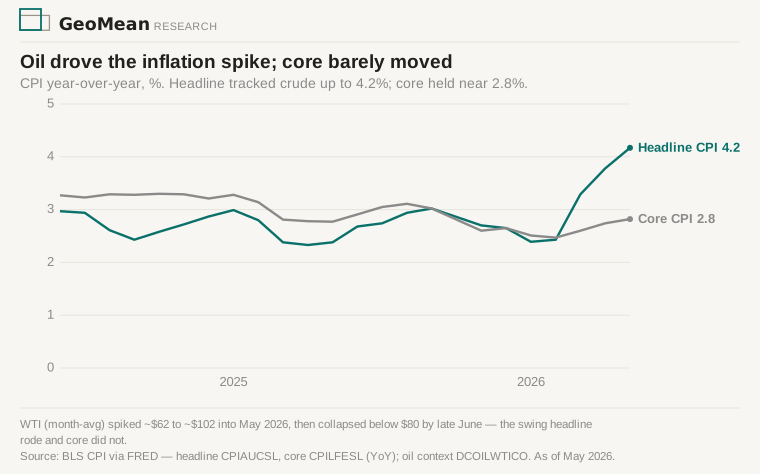
The case against the projected hike is really a case about energy. Headline CPI ran 4.2% in May, and more than 60% of the monthly rise was energy (BLS); the same force that drove inflation up is now running in reverse, with crude down roughly 25% from its war peak into the low $70s after the June 18 Iran deal. (FRED’s daily WTI series lags at $84.65 on June 15; the post-signing spot is lower.) Take energy back out and the disinflation is largely arithmetic — which is exactly why the market treats the hike projections as noise.
But oil is no longer a one-way bet. US crude inventories are near their lowest in a decade, and the physical-scarcity argument runs that a price this low against demand this high can’t hold — depleted stockpiles eventually have to be refilled, which would push crude materially higher. The sharper warning came from the other side of the debate. Wang, a former trader on the Fed’s open-market desk who has called this “a large disinflationary wave,” noted in the same breath that Hormuz had reportedly re-closed after Israel bombed Lebanon. When the disinflation camp’s own members are flagging the supply risk, the floor is thinner than it looks.
The voices who called crude lower have been right on direction. Quinn Thompson (Forward Guidance) called an $80 floor in April — “not going back to $60” — and with crude in the low $70s that floor has been breached; Roberts’s call for oil to resolve into the $60–75 range and the “$70s on reopening” from Darius Dale (42 Macro) are tracking. The directional bears have earned the benefit of the doubt here. But “lower” and “stable” are different claims, and the harder, less crowded one is that the bottom is physical, not political. If that’s right and Hormuz stays contested, the hike projections stop being stale and become live.
Next week’s PCE print can’t settle the inflation path
Wednesday’s core PCE — part of BEA’s Personal Income & Outlays release, where the consensus looks for 0.3% on the month against 0.2% prior — can’t adjudicate the inflation question. Energy moves into the index with a lag, so this print is still riding the prior spike; a core PCE above consensus confirms last quarter’s oil, not next quarter’s path. The release that can change the picture is the same morning’s personal income and spending, because that is where the other half of the case for cuts — a consumer that can absorb a tighter Fed — actually gets tested.
The hard data leans toward a stressed consumer. University of Michigan sentiment sits at 49.8, near a record low; the savings rate has fallen to 2.6%; and real wages are running about −0.8% year over year (our May jobs detail). Roberts argues the sentiment number is unreliable — politically skewed, and contradicted by a bottom-half balance sheet that has improved since 2020 — and prefers the steadier Conference Board read. He may be right that the survey overstates the gloom; the resolution is in spending, not surveys. A soft spending print against a 2.6% savings cushion would say the Fed is tightening into a household with nothing left to draw down.
Semiconductors carry the rally — and the oil bet’s downside
The equity rally that has priced the benign outcome — no hike, fading inflation, new highs — is concentrated in a way that leaves little room for the oil bet to go wrong. Roberts puts a number on it: semiconductors are now about a fifth of the S&P 500, against roughly 9% in 2000, and are discounting 2028–2029 earnings while retail margin debt sits at records. “Those stocks have gotten way, way ahead of themselves… I would take profits. I would hedge.”
Jim Chanos, the short-seller who called Enron’s collapse, draws a finer line on Monetary Matters: he is long what the chips produce — the index itself — and short the “financial middlemen,” the unprofitable AI-infrastructure lessors earning 5–8% on capital. “Bull markets put a premium on forecasts and bear markets put a discount on reality.” Both warnings point at the same fragility as the oil one: a market this concentrated has no cushion if the rates picture shifts, and the rates picture shifts the moment oil stops falling.
Last week’s report argued that cheaper oil would never reach the cost increases already in the supply chain. Investors are making the opposite bet — that oil fixes the whole problem. This week added the part neither side had priced: the oil price itself may not stay cheap.
Snapshot
Levels as of June 18–20, 2026
| Level | Note | |
|---|---|---|
| Fed funds | 3.50–3.75% | held Jun 17; dots flipped to a 2026 hike |
| US 2Y / 10Y / 30Y | 4.20 / 4.49 / 4.93% | long end held through the higher-rate projections |
| WTI crude | low $70s (spot) | ~−25% from the war peak; FRED daily $84.65 (Jun 15) |
| CPI / core CPI | 4.2% / 2.8% | headline driven by energy; core contained |
| S&P 500 | 7,501 | near record; semis ~20% of the index |
| UMich sentiment | 49.8 | near a record low |
| Savings rate | 2.6% | cushion depleted |
Watching
- Core PCE — Wednesday, Jun 25 (cons. 0.3% m/m): elevated on lagged oil; confirms the past, not the path.
- Personal income & spending — Jun 25: the real consumer test — a soft spending print against a 2.6% savings rate is the growth tell.
- The oil price & Hormuz status: what the whole case for cuts turns on. Crude back above ~$90, or a confirmed strait re-closure, revives the hike.
- Q1 GDP final + durable goods — Jun 25; JOLTS — Jun 30.
Sources
Data: BLS CPI (May); BEA Personal Income & Outlays (core PCE — Jun 25 release); FRED (WTI DCOILWTICO, SP500, Treasury yields, UMich sentiment, savings rate). Voices: Lance Roberts, Thoughtful Money; Joseph Wang, Fed Guy “Markets Weekly Jun 20”; Jim Chanos, Monetary Matters; Forward Guidance weekly roundup. Builds on our Jun 19 FOMC read and the May CPI / PPI deep dives.