Correction and vintage note — July 16, 2026. BLS revised February–May 2026 with the June release (USDL 26-1193). Four figures below are superseded, one claim is now false, and the central thesis was wrong.
- “Producer prices rose 1.1 percent in May… putting the annual rate at 6.5 percent” — restated to 0.6 percent and 6.0 percent.
- “Final demand goods rose 2.8 percent — the largest monthly increase in the series’ history” — restated to 2.3 percent, which is not the record. The largest remains March 2022, at 2.5 percent. The claim was accurate on the vintage available at publication and is false on the current one.
- “Energy +10.7 percent, gasoline +23.4” — restated to 8.4 and 20.9.
- “[Trade margins] fell 1.1 percent in May” — restated to −2.3 percent, a deeper compression than reported here.
The thesis failed on its own terms, not on the revisions. This piece argued that distributor margins were a finite buffer absorbing the cost surge, and named their re-expansion as the signal that the increase had reached consumers. Trade margins are up 3.3 percent over the twelve months through June and flat against February — they did not compress across the shock, and there was no stored increase behind them. The June PPI analysis carries the correction and the self-score.
Summary of May PPI, June 11, 2026
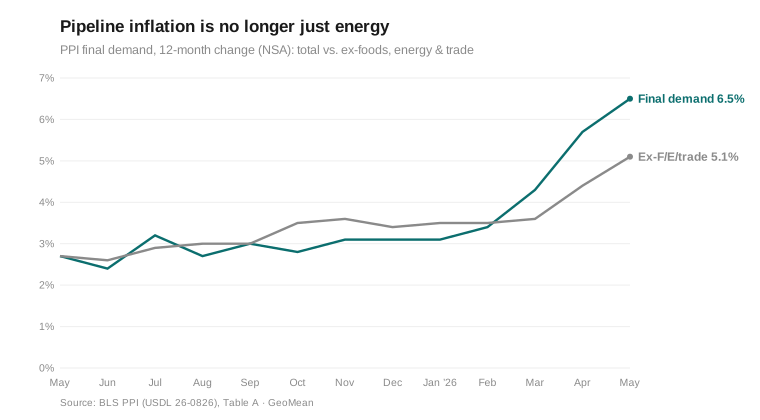
- Producer prices rose 1.1 percent in May against a 0.8 consensus, putting the annual rate at 6.5 percent — the most since November 2022.
- This time it isn’t just energy: the supercore producer measure rose 0.8 percent, its largest monthly advance in four years.
- The monthly path is accelerating — 0.5, 0.5, 0.2, 0.5, 0.8 since January — not a one-time energy pass-through.
- The only thing keeping that cost pressure out of consumer prices is distributor margins, and they compressed again in May.
The Producer Price Index for final demand rose 1.1 percent in May against a 0.8 consensus — the second straight 1.1 — putting the 12-month rate at 6.5 percent, the largest since November 2022. Yesterday’s CPI left one question open: is the energy shock leaking toward core, or is the upstream cost pipeline still quiet? The answer is unambiguous. Upstream costs are building.
Supercore producer prices just printed a four-year high
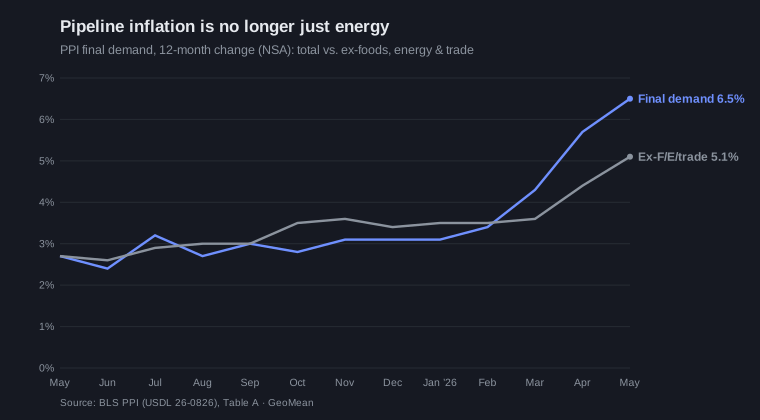
Strip out foods, energy, and trade margins — the cleanest producer-side core — and final demand still rose 0.8 percent in May, the largest monthly advance since March 2022, taking its 12-month rate to 5.1 percent (largest since October 2022). The monthly path since January: 0.5, 0.5, 0.2, 0.5, 0.8 — accelerating, not a one-time energy pass-through. At the consumer level, core CPI is running a 0.2 monthly cadence; at the producer level, its counterpart just ran 0.8.
Goods drove the print, at a record monthly scale
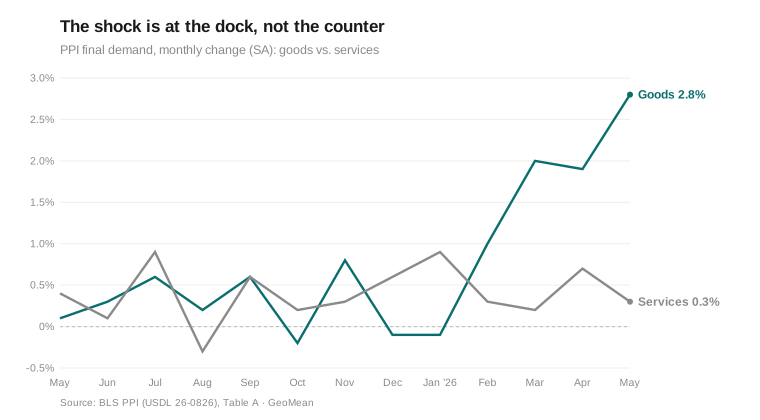
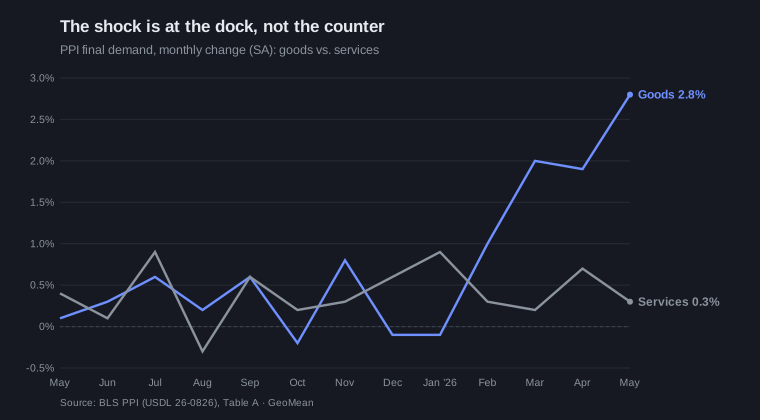
Final demand goods rose 2.8 percent — the largest monthly increase in the series’ history (data begin December 2009) — and accounted for roughly 80 percent of the headline advance. Energy drove most of it (+10.7 percent, gasoline +23.4), but goods ex foods and energy also rose 0.8. Services rose just 0.3.
Earlier production stages are rising faster than final demand
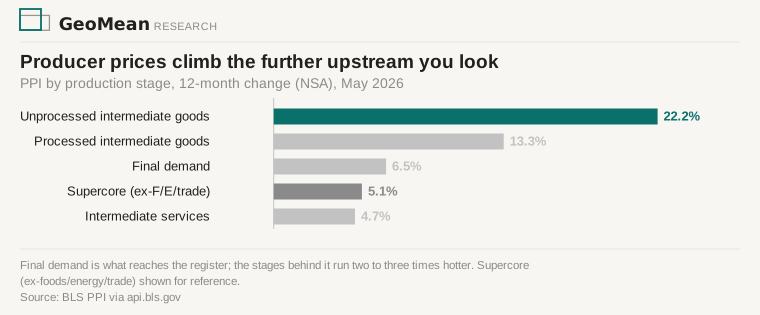
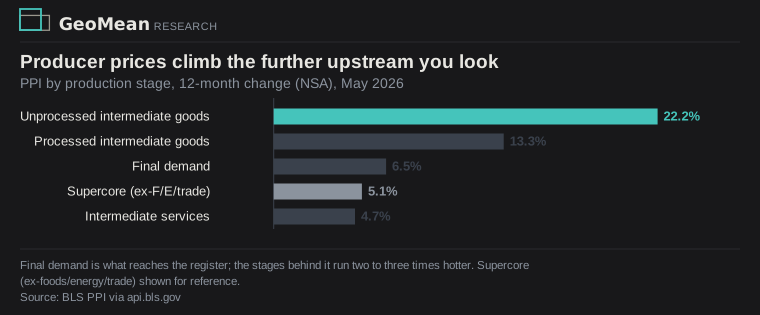
Behind final demand, each earlier production stage is rising faster than the one after it: unprocessed intermediate goods +22.2 percent on the year, processed +13.3 (both multi-year records), intermediate services 4.7, stage-3 inputs +1.9 on the month, stage-4 +1.1. Cost pressure that far up the production chain takes quarters to reach final goods — and is hard to stop once moving.
Distributor margins are absorbing the cost increase
Trade margins reconcile a 6.5 percent PPI with a 2.9 percent core CPI, and the release states it plainly: they fell 1.1 percent in May. Trade indexes measure what wholesalers and retailers keep — and they compressed in the same month input costs surged at record pace. Distributors are absorbing the increase rather than passing it to the register. That is why the consumer core stayed quiet yesterday — and it cannot run indefinitely. The month trade margins re-expand while input costs are still climbing is the month the increase reaches consumer prices. That series — not the headline — is now the single most important number in the inflation data.
One discount on the services side: portfolio management rose 4.8 percent and drove over 40 percent of the services advance — a PPI component that tracks asset prices and fees, not production costs. Strip it out and producer services look tamer than the print suggests.
May’s PPI strengthens the hike case
Yesterday’s CPI supported both sides of the hike debate; this print adds weight to the hike case. The hike case — David Cervantes (Pinebrook Capital) — gains building upstream cost pressure, a supercore producer measure at four-year highs, and a beat against consensus. The no-hike case — Lance Roberts (RIA Advisors) — now requires the energy shock to unwind before the margin buffer exhausts: possible, since the Hormuz reopening is barely two weeks old and crude-sensitive lines dominate the increase, but the window narrowed. The tracked maximalist call — that PPI leads CPI into 6-percent consumer prints — has materially more support than it did a week ago. The Warsh FOMC meets in five days staring at headline CPI 4.2, core CPI 2.9, PPI 6.5, supercore producer 5.1, and a distributor margin that determines which of those numbers reaches consumers next.
Sources: BLS Producer Price Indexes — May 2026 (USDL 26-0826); Table A transcription, verified figures, and the extended analysis are archived in the GeoMean data files. Companion: May CPI deep dive. Note: January–April figures reflect this release’s revisions.