Summary of the May Jobs Report, June 5, 2026
- Payrolls rose 172,000 against an 80,000 consensus, and prior months were revised up 93,000 — a firm headline that removes the case for a near-term rate cut.
- Underneath, the trend is stall speed: private hiring has slowed from about 350,000 a month in 2022 to roughly 56,000, and government is shrinking on net.
- Full-time employment is down 600,000 on the year, and 94 percent of May’s gain came from just three acyclical sectors.
- One strong month built from government and seasonal leisure hiring does not reverse that trend.
Total nonfarm payrolls rose 172,000 in May, more than double the 80,000 economists expected — Vanguard and Goldman Sachs looked for 20,000 to 60,000 — and the unemployment rate held at 4.3 percent. Revisions ran upward for once: March was marked up 29,000 (to 214,000) and April up 64,000 (to 179,000), 93,000 higher combined. On the top line alone, this was an unambiguous beat that removes the case for a near-term rate cut.
The tables underneath show something else: a labor market that has downshifted to stall speed, with May’s gain built almost entirely from sectors that don’t move with the business cycle.
Hiring has collapsed since 2022
The single most important number is not in the release; it is the trend the release sits on. On the current, fully revised data, private payroll growth has slowed every year — averaging about 350,000 jobs a month in 2022, then 149,000 in 2023, 85,000 in 2024, 25,000 in 2025, and roughly 56,000 over the past year. These are post-revision figures, and the revisions have been severe: the March 2025 benchmark cut payroll levels by 861,000 (−0.5 percent; −898,000 seasonally adjusted) — the second-deepest cut in the series’ history back to 1979, behind only 2009 — after 2024’s −598,000. Together they are the largest two-year benchmark cut on record, the third straight negative year, and roughly 3.5 times the prior decade’s average revision. That overcount is already baked into the numbers above; the most recent months, not yet benchmarked, risk being marked lower still (more on the revision regime).
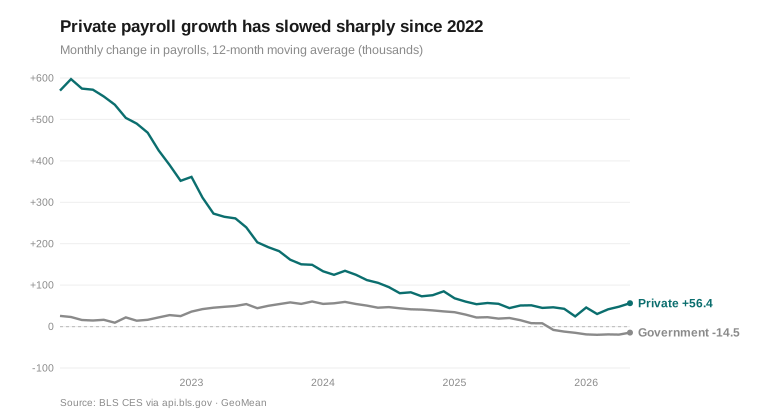
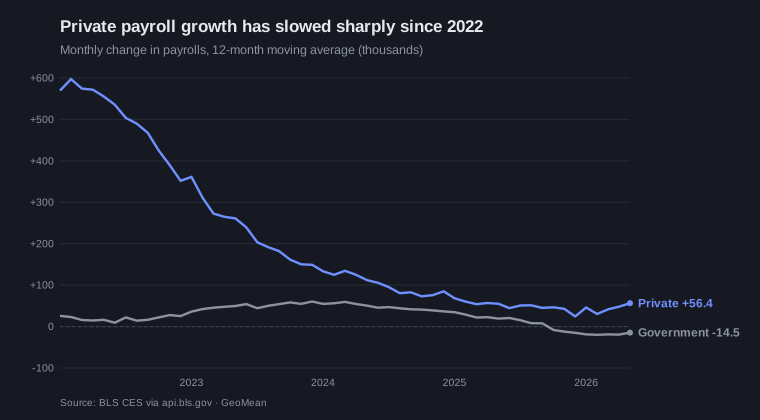
May’s headline splits into private +120,000 and government +52,000. That government figure is the tell: government employment has shrunk on net over the past year — about 15,000 jobs a month — so a +52,000 month, almost all of it local government, runs against its own trend. Strip out that one-month public-sector bounce and the private economy did what it has done all year: hire at a fraction of its former rate.
May’s gain was three acyclical sectors
Breadth looks healthy by head count — 10 of the 14 CES supersectors added jobs — and deceptive by magnitude. The top three were 162,000 of the 172,000, and all three are acyclical: leisure and hospitality (+70,000), government (+52,000), and education and health (+40,000).
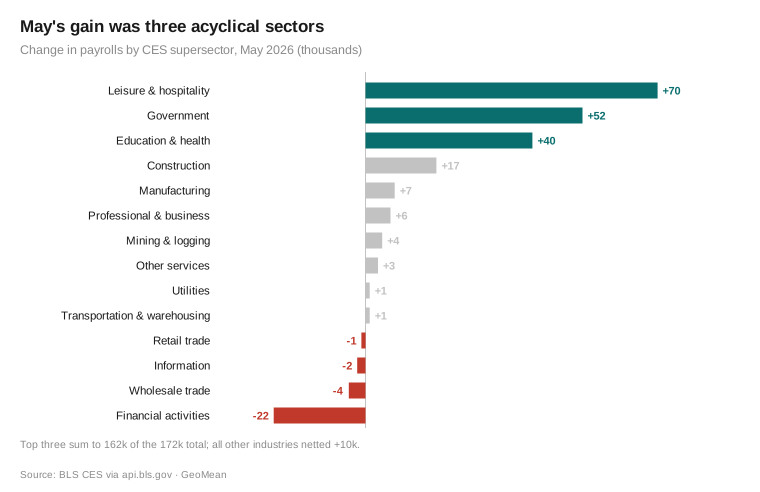
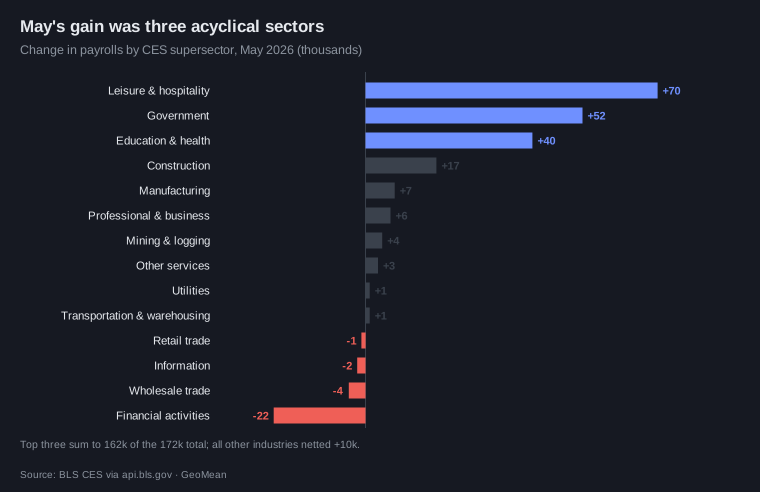
The cyclical, rate-sensitive economy barely moved or shrank: financial activities lost 22,000 and is down 107,000 since its May 2025 peak; wholesale trade fell 4,000; manufacturing and professional and business services rounded to flat. The leisure-and-hospitality line is the one to discount: at +70,000 it ran five times its 12-month average of 14,000, a category prone to spring seasonal-adjustment swings, and ADP’s parallel survey put the same sector at just +8,000. When two payroll surveys diverge that far on one sector, the gap is in the seasonal factors, not the economy.
Full-time work is shrinking
The household survey, volatile but harder to dress up, shows the deterioration plainly. Full-time employment is down 600,000 over the year while part-time work has risen 132,000 — and part-time for economic reasons, people who want full-time hours but can’t get them, is up 181,000.
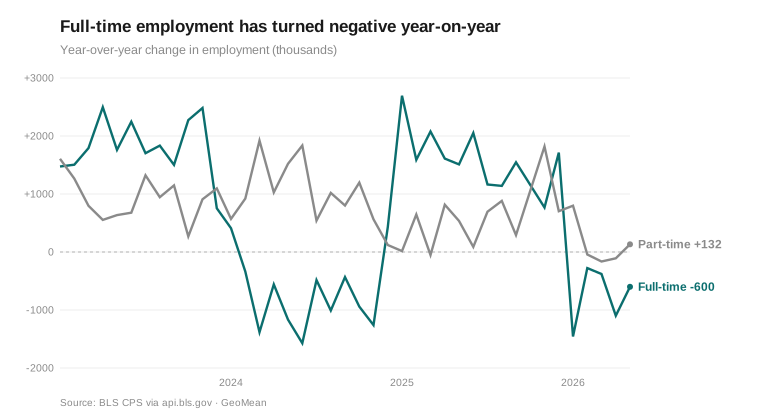
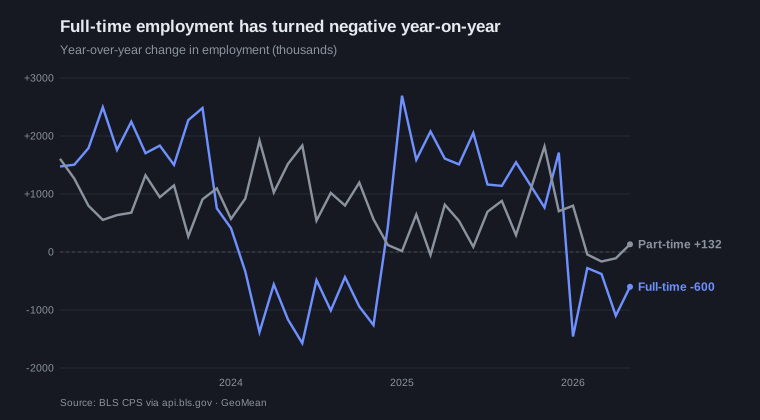
This is not the headcount being propped by second jobs: multiple jobholders held flat at 5.2 percent of the employed. It is a genuine shift in the quality of work. The unemployment rate is steady at 4.3 percent, but the long-term unemployed — jobless 27 weeks or more — are up 524,000 over the year and now make up 27.5 percent of all unemployed. That is the signature of a low-hire, low-fire market: few layoffs, but anyone who loses a job stays out far longer.
Foreign-born and native-born employment are both falling
For most of the post-pandemic expansion, foreign-born workers drove employment growth — roughly 19 percent of the employed but more than half of the job gains from 2021 to 2024 (+5.1 million, versus +4.5 million native-born off a far larger base). That has reversed. In the year to May 2026, employment fell for both groups: foreign-born down 107,000, native-born down 396,000.
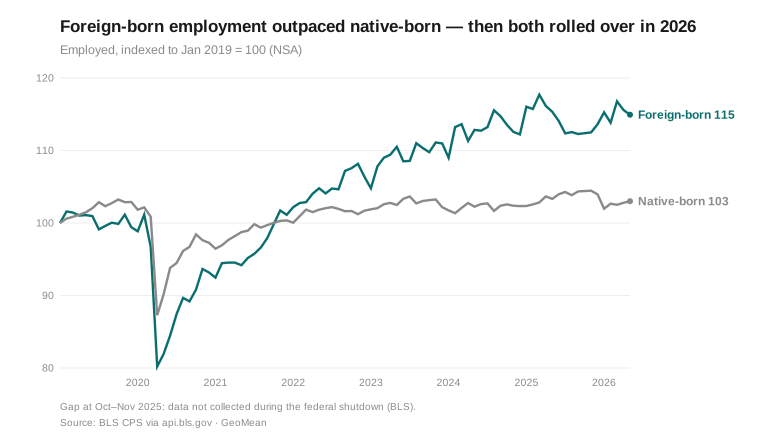
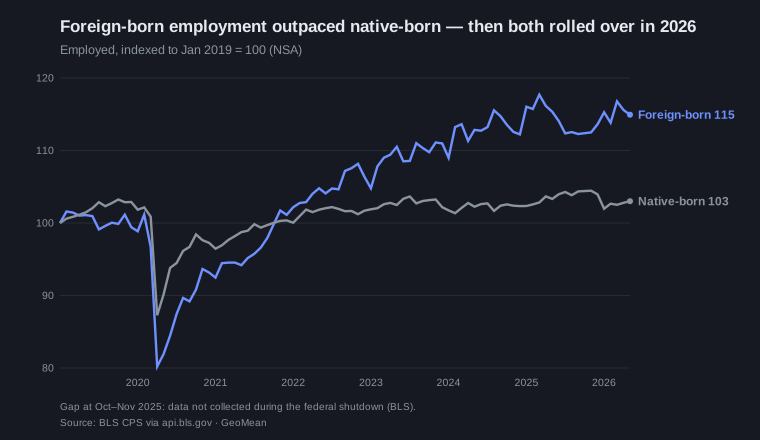
One caveat: January 2026 estimates were re-based on updated population controls, so year-over-year nativity comparisons spanning that break are partly definitional — the direction is reliable, the exact figures are not. And the direction is unambiguous: the foreign-born workforce that drove post-pandemic job growth is now shrinking, and native-born employment is falling with it.
Every independent tracker shows the same pause
The cross-checks line up. ADP counted 122,000 private jobs — within 2,000 of the BLS private figure once government, which ADP doesn’t measure, is set aside. Indeed’s job-postings index sits about 2 percent above its 2020 baseline, near a five-year low, with posted-wage growth down to 2.3 percent — below CPI. Bank of America’s deposit data shows hiring still positive but concentrated in lower-income work. Every instrument gives the same reading: a labor market in pause, with the hiring that remains tilted to the low-wage end.
Wages fit the same picture — firm, not accelerating. Average hourly earnings rose 0.3 percent on the month and 3.4 percent over the year, to $37.53, with the workweek unchanged at 34.3 hours. Against May CPI that is roughly flat in real terms — not the acceleration the headline beat suggests.
A strong month doesn’t reverse a stalled trend
The print counts against a near-term rate cut: 172,000 over an 80,000 consensus, with revisions up, is not a number the Fed can wave away. But the case for cutting was never the monthly headline; it was the trajectory — and the trajectory shows hiring slowed to stall speed: the gains are narrow and defensive, full-time work is contracting, and every alternative tracker confirms a market in pause. A single strong month built from government and seasonal leisure does not reverse that. The next release lands Thursday, July 2; the question is whether May’s beat was the floor or the outlier.
Sources: BLS Employment Situation — May 2026 (USDL-26-0786) and the underlying CES/CPS series via api.bls.gov; CES benchmark article (March 2025, −898k); consensus via CNBC / Dow Jones; ADP; Indeed Hiring Lab; BofA Institute. All figures, flat-file history (2006–2026), chart source, and the extended analysis are archived in the GeoMean data files.