Summary for the Week of September 4, 2026
- Governor Waller is “inclined to support holding” if disinflation continues in the next two weeks’ data; the labor market is “not a large factor” (Fed, archived); hike odds fell from about 63 percent to 48 (CNBC).
- August payrolls rose 162,000 against a 53,000 consensus, 683,000 people joined the labor force, and wages rose 3.1 percent from a year ago, the slowest since May 2021 (BLS, archived).
- Brent rose 7.6 percent to $92.68 as the US and Iran traded strikes (Reuters).
Governor Christopher Waller set a public condition on Thursday — hold if disinflation continues in the next two weeks’ data — and said the labor market was “not a large factor” in his vote. Friday’s jobs report beat the consensus by 109,000, and futures moved from 50 to 60 percent for a hike on a report he had expected to be “more of the same.” Waller’s vote now turns on Friday’s CPI; investors did not wait for it.
Waller’s condition is August’s inflation data, and he discounts the imputed half of July’s core
His reason is the trend: three-month core PCE “has fallen steadily from 4.76 percent in February” to 3.05 percent through July. What “caught my eye” in July was that nonmarket service prices — “imputed and not actual price changes” — were about half of the core increase.
On his own description that is “the fees paid to stock market traders and related professionals” — the portfolio-management line the July PCE note measured at 46 percent. Without it, July’s core rose 0.14 percent and runs 3.0 percent over 12 months against 3.3 with it.
The fee explains July’s month, not the level: core sits a point above target without it, and Waller said policy is “only slightly restricting aggregate demand” — a case for waiting, not for stopping. BEA’s change to that estimate, which he calls “a welcome measurement correction,” could lower 12-month PCE “by a few tenths of a percentage point”; it lands September 30, after the vote.
Payrolls rose 162,000, and futures repriced on the report Waller said would not move him
July’s −23,000 was the no-hike side’s strongest number. It was revised to +21,000, and August added 162,000. After 720,000 people left the labor force in June and 264,000 in July, 683,000 came back, and unemployment held at 4.1 percent with the labor force growing. One month proves little: the three-month net is still −301,000.
The report had no wage pressure in it. Average hourly earnings rose 3.1 percent from a year ago, the slowest since May 2021 and about 0.3 points below July’s consumer inflation, and two low-wage, acyclical sectors — food services and local school districts — supplied 101,000 of the 162,000. Investors repriced on the payroll beat, not the wage number: from about 50 percent Thursday to 58 to 60 by Friday’s close (CNBC; Reuters).
Oil and input costs rose the week Waller argued for patience
Brent gained 7 percent over Monday and Tuesday after Iranian forces hit three tankers leaving the Gulf on August 30 and 31, two of them on the US-escorted southern route that Iran calls unauthorized; the US struck rebuilt Iranian radars on September 1 and destroyed three Iranian tankers by September 5 (Critical Threats; Euronews). Brent gave part of it back, to $92.68 Friday, as escorts kept the route at about half its pre-war traffic.
The August surveys — ISM publishes no collection window, but the month ended a day after the first tanker attack — already had input costs rising: ISM’s services prices index was 72.6, its highest since August 2022, and factories reported a 23rd straight month of rising input costs (ISM). Waller’s text says his worry that higher energy prices would bleed into other goods and services prices “hasn’t come to pass, at least so far”; August CPI tests that.
Thirty-year yields moved two basis points, and Waller’s vote turns on Friday’s CPI
The 30-year closed at 5.24 percent, two basis points above the prior Friday, through the jobs report and the oil move (Treasury, archived); on the jobs report it fell one basis point while the two-year rose three.
David Rosenberg (Rosenberg Research) attributes the 2026 rise in long-term yields to the Fed — two-thirds of it, he says, came on Warsh’s three speaking days. On Treasury closes those days sum to 18 basis points: over half the rise since June, but a fifth of the 81 since February’s low. Mohamed El-Erian (Allianz) reads the rest as supply — more issuance, fewer reliable buyers (CNBC).
Thursday’s buyback is a narrow test of the supply reading: Treasury’s first enlarged operation — $4 billion of 10-to-20-year bonds, on a schedule that still lists $2 billion 20 days after the announcement (Treasury) — adds $2 billion against the two sessions of relief August’s operations bought.
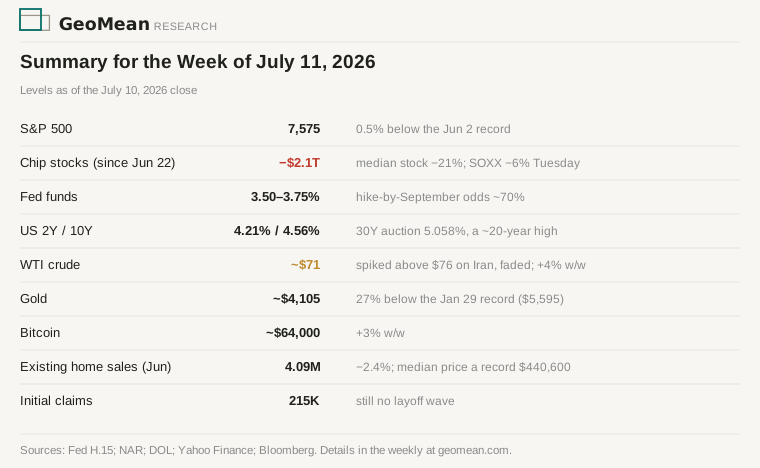
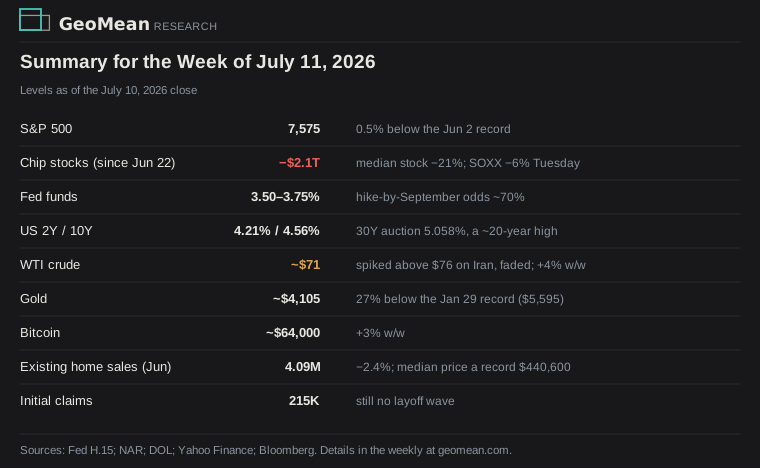
Snapshot
Watching
- Thu Sep 10 — PPI (consensus core +0.3%), the first $4 billion buyback (10-to-20-year bonds), and August existing-home sales — the first resale report with mortgage rates at 6.7 percent.
- Fri Sep 11 — August CPI. Consensus core +0.2 percent, 2.4 percent over 12 months. Waller’s condition. He named no threshold — “it may not take much acceleration in inflation to nudge me” — and a 0.3 against a 0.2 consensus is one.
- Wed Sep 16 — the FOMC, with projections, and August retail sales. Joseph Wang (Fed Guy) at 90 percent a week ago; Rosenberg and Bob Haber (Proficio) on no hike.
- Thu–Fri Sep 17–18 — the Bank of Japan, which Governor Kazuo Ueda says will consider a hike “at every policy meeting” (Nikkei); the yen crossed 160 early in the week and closed near 156 after Japan spent ¥15.4 trillion on intervention between July 30 and August 26 (MOF).
- Wed Sep 30 — August PCE and BEA’s annual update, which changes how the fee line is priced.
Correction
September 19, 2026 — Brent crude settled at $96.28 on September 4, not the $92.68 this piece printed in its summary, its oil section and its snapshot. The Reuters report it relied on carried the wrong level; that report’s own daily change, 76 cents or 0.8 percent, matches $96.28, as does the next week’s 8.7 percent gain to $104.61. The 7.6 percent weekly rise is unaffected.
Sources
Data: BLS Employment Situation, August 2026 · BLS JOLTS, July 2026 · ISM manufacturing · ISM services · Treasury daily yield curve · Treasury buyback announcement and tentative schedule (August 5 version, archived) · Waller, “The Economic Outlook and Some Comments on My Policy Communication” · Beige Book · Fed pricing: CNBC Sep 3, CNBC Sep 4, Reuters · consensus: CNBC · Hormuz: Critical Threats, Euronews · Japan: Nikkei, MOF, CNBC. Voices: Joseph Wang, Markets Weekly Sep 5 · Bob Elliott, Macro Talk Sep 4 · David Rosenberg on Thoughtful Money · Michael Every on TFTC · Mohamed El-Erian, CNBC Sep 4 and Weekly Look Sep 6 · Bob Haber and Matt Hougan on Forward Guidance. Builds on the July PCE note and the August 30 weekly. Figures verified and archived in the GeoMean data files.