Summary of the June FOMC, June 17, 2026
- The Fed held at 3.50–3.75% on a 12-0 vote — fully priced, which put all the news in the projections, not the rate.
- The dot plot flipped from a bias to ease to a bias to tighten in one meeting: nine of eighteen now project at least one 2026 hike.
- The projections moved both ways — 2026 inflation marked up to 3.6% headline / 3.3% core (from 2.7%), growth cut to 2.2%.
- The decision is orthodox price-stability policy; the watch item is the new chair’s five-task-force overhaul of the institution itself.
- Bond investors didn’t buy the move — the 10-year held through the higher-rate projections.
Markets priced the hold; the dot plot carried the news
The Committee left the funds rate at 3.50–3.75% (effective 3.63%) on a 12-0 vote — an outcome futures had fully priced, which made it a non-event in the rate and put all the information in the projections. There the news was real: the median policymaker now sees the funds rate ending 2026 at 3.8%, up from 3.4% in March; nine of eighteen project at least one hike this year and six project two. The dots flipped from a bias to ease to a bias to tighten in a single meeting — a unanimous hold from a committee signaling, not yet acting.
Projections mark higher inflation and lower growth at once
The Summary of Economic Projections moved in two directions at once. The 2026 inflation forecast rose to 3.6% headline and 3.3% core — roughly nine-tenths of a point above March’s 2.7% — while growth was cut to 2.2% from 2.4% and the unemployment path nudged to 4.3% from 4.4%. Higher inflation, lower growth: in its own numbers the Fed has sketched a stagflationary mix, and its projections lean against the inflation side of it. That is defensible, but it is a choice — prioritizing price stability as its own growth forecast softens.
Warsh rewrote the statement, not just the dots
The communication change carried as much signal as the dots. The post-meeting statement lost the language that had tilted toward future easing and came out far shorter — “a bit shorter, a bit simpler,” in the framing of Kevin Warsh, the new chair chairing his first meeting, who dispensed with older boilerplate. Removing an easing tilt is itself a change in forward guidance. The first Warsh statement reads as a deliberate reset of how the Fed talks, alongside the announcement of five “independent” task forces — on communications, the balance sheet, and other operations, staffed by experts inside and outside the institution — chartered to report by year-end.
Bond markets priced a hike, not a hiking cycle
Bond investors were skeptical. The two-year yield rose toward 4.2% as traders priced in the hike, but the ten-year held near 4.5% straight through the higher-rate projections and the thirty-year sat near 4.9% — investors priced one hike, not a sustained cycle.
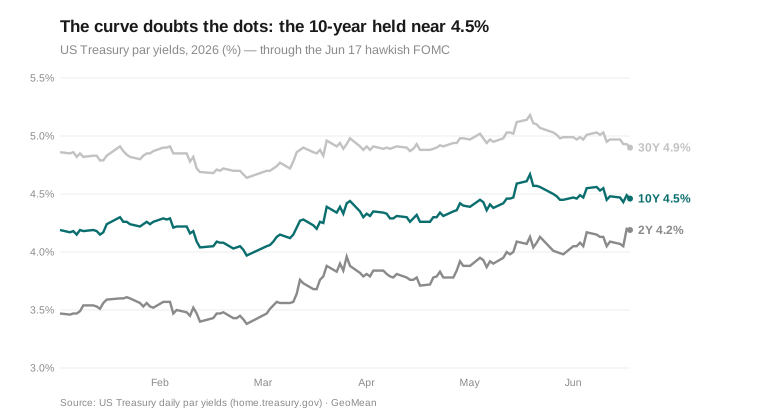
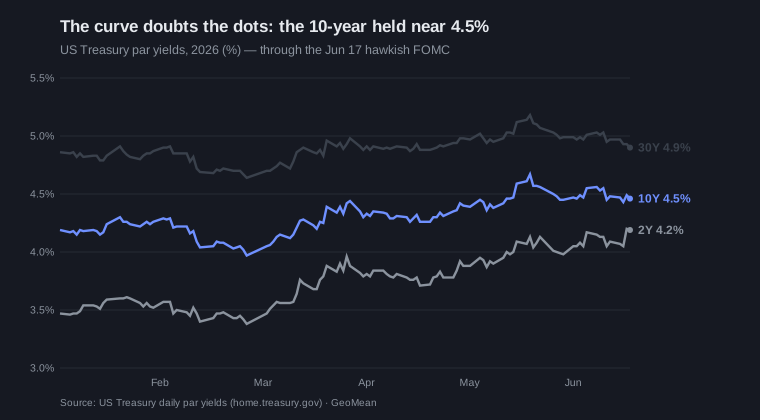
A ten-year that won’t break higher while the dots move up means investors expect the tightening won’t last — because growth gives way first, or because long-term yields are held down by demand the Fed doesn’t control. Either way, the gap between the Fed’s projections and the market’s pricing is the thing to watch: the dots project one to two hikes; bond prices imply the Fed won’t get there. Precedent backs the skeptics. When the Fed projects hikes just as the data turns, those projections have a record of under-delivering and reversing — its December 2018 projections became three cuts in 2019 — because the dots follow the data, not the other way around. And this surprise arrives as oil, the inflation forecast’s main driver, falls roughly a quarter off its early-June high: the 2018-19 pattern, not the 2021-22 one, when projected hikes undershot inflation that kept accelerating.
Oil reversed as the Fed raised its inflation forecast
The projections have a timing problem. The committee raised its inflation forecast off the May prints — a CPI that was more than 60% energy and a record jump in producer goods — in the same week that energy shock began to unwind, crude down roughly a quarter from its early-June high on the Iran deal. The Fed hardened against an inflation impulse as its single largest driver reversed. The growth cut, by contrast, fits the data cleanly: May payrolls were stall-speed beneath a firm headline. So the forecast is half-confirmed and half-backward-looking — and the incoming data is already undercutting the higher-rate half.
Rate policy is orthodox; the overhaul is the open question
A new chair invites the political-influence question. The evidence answers it: tightening into a 4.2% CPI is textbook price-stability policy, and a Trump-appointed chair signaling higher rates is the opposite of pressure for easy money — a captured Fed does not flip its dots to a hike into a slowing economy. On the rate decision the evidence argues asserted independence, not influence.
The open question is elsewhere. The five-task-force overhaul of the Fed’s communications and balance-sheet operations, staffed from inside and outside the institution, is the kind of structural reshaping where legitimate modernization and a channel for influence look identical from the outside — distinguishable only by what the task forces eventually recommend. This is not a capture claim; there is no evidence for one, and the policy points the other way. It is a flag: the rate decision can be judged against the data; the reorganization of the institution is the thing to watch.
Sources: FOMC statement and Summary of Economic Projections, Jun 17 2026 (federalreserve.gov); decision and projections coverage (CNBC); the task-force overhaul (American Banker, CNBC live). Curve: US Treasury daily par yields (primary); the archived series and verified figures are in the GeoMean data files. Cross-asset read in the weekly; inflation thesis in inflation.