Whether the Fed’s quarterly dot-plot projections actually predict where rates go — and how to read a fresh surprise when the dots move.
Short answer: no — the dots follow the data, not the reverse
The dots are a poor predictor of the Fed’s own future actions, and the direction of the error depends on the regime. Each dot is a participant’s projection conditional on their forecast — recent data extrapolated forward — so the dots lag turning points and get overruled by the next data.
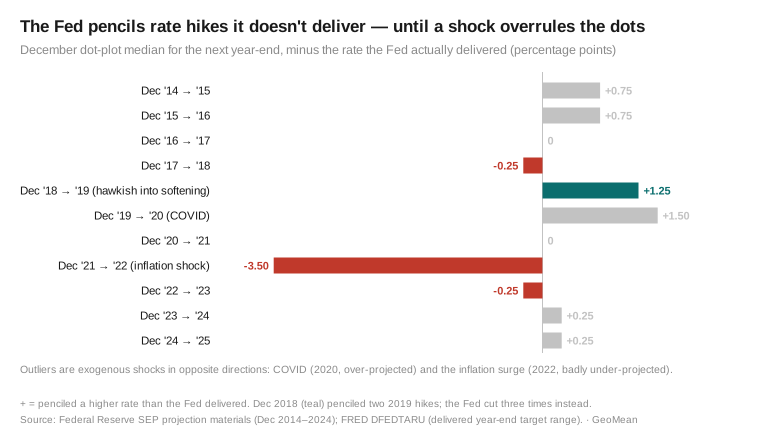
Comparing each December dot-plot median for the next year-end against the rate the Fed actually delivered (2014–2024) bears this out:
- In the 2015–2019 normalization, the Fed ran its projections ~0.5 percentage points too hawkish per year on average — it kept penciling more hikes than it delivered.
- December 2018 is the cleanest case of a hawkish dot into a slowing economy: it penciled two more 2019 hikes, then the Fed cut three times in 2019 — a 1.25-point miss that reversed direction entirely. Its own January 2019 minutes conceded the projections “do not accurately convey the Committee’s policy outlook.”
- The big misses go both ways, and both came from exogenous shocks: COVID (Dec-2019 dots over-projected 2020 by 1.5pp) and the inflation surge (Dec-2021 dots under-projected 2022 by 3.5pp — the largest forecast error since the 1970s, where dovish dots met accelerating data and the Fed over-delivered).
Penciled vs. delivered, every year since 2014
December SEP median for the next year-end (midpoint of the target range) vs. the realized year-end rate. Gap = penciled − delivered; a positive gap means the Fed projected a higher rate than it delivered (over-promised hikes).
| December SEP | Penciled (next yr-end) | Delivered | Gap | What happened |
|---|---|---|---|---|
| Dec 2014 | 1.13% (for ‘15) | 0.38% | +0.75 | penciled ~4 hikes for 2015; the liftoff slipped to December |
| Dec 2015 | 1.38% (for ‘16) | 0.63% | +0.75 | penciled ~4 hikes; delivered one |
| Dec 2016 | 1.38% (for ‘17) | 1.38% | 0.00 | on target (three hikes) |
| Dec 2017 | 2.13% (for ‘18) | 2.38% | −0.25 | did slightly more (four hikes) |
| Dec 2018 | 2.88% (for ‘19) | 1.63% | +1.25 | penciled two hikes; cut three times |
| Dec 2019 | 1.63% (for ‘20) | 0.13% | +1.50 | COVID → emergency cut to zero (exogenous) |
| Dec 2020 | 0.13% (for ‘21) | 0.13% | 0.00 | zero-bound hold |
| Dec 2021 | 0.88% (for ‘22) | 4.38% | −3.50 | inflation shock; hiked far more, far faster |
| Dec 2022 | 5.13% (for ‘23) | 5.38% | −0.25 | ~on target |
| Dec 2023 | 4.63% (for ‘24) | 4.38% | +0.25 | cut slightly more than penciled |
| Dec 2024 | 3.88% (for ‘25) | 3.63% | +0.25 | cut slightly more than penciled |
Sourced to the Fed’s own projection materials (median funds-rate row of each December SEP table) and FRED DFEDTARU for the delivered rate; the underlying series and pull scripts are archived in the GeoMean research files.
Why: a dot is an extrapolation, not a commitment
Each dot is conditional on a forecast, and FOMC forecasts are slow to incorporate new information (SF Fed, 2024), so the dots lag the turn. Whether the Fed follows through comes down to one thing: does the data that drove the surprise persist? When it does (2022 inflation), the Fed delivers and then some. When it doesn’t (2019), the projected hikes never come.
Reading a fresh surprise: match it to the regime, then watch the driver
To judge whether a new dot-plot surprise will hold, sort it into one of two configurations:
- Surprise into accelerating data (2021 → 2022): dovish dots met still-rising inflation. The Fed over-delivered. A hawkish dot into still-hot data resolves the same way — the projection understates what’s coming.
- Surprise into softening data (Dec 2018 → 2019): a hawkish dot landed as the economy slowed. The penciled hikes never came, and the Fed reversed. The base rate for this setup is under-delivery, with outright-reversal risk if the data keeps softening.
The deciding series is the one that drove the surprise — for an inflation-led surprise, core PCE. If the next prints confirm the dots, the year rhymes with 2022; if they undercut them, it rhymes with 2019. Bond investors often signal which read they favor before the data settles: a 10-year yield that holds through hawkish dots means they are pricing in under-delivery.
Caveat: the median hides the distribution
The dot is a median; the spread around it matters. A bimodal hawkish surprise is weaker guidance than a consensus one. One data note: the 2014 median predates the Fed printing an explicit median row, so it is reconstructed from the dot distribution and the SEP narrative; all other years read directly from the published median.
Sources
- Federal Reserve SEP projection materials, December 2014–2024 (
fomcprojtabl*.pdf) — the median funds-rate projection at each meeting. - FRED
DFEDTARU— delivered year-end federal funds target range (upper limit). - Federal Reserve, “Anchored to the Dot Plot” (FEDS); SF Fed, “Examining the Performance of FOMC Inflation Forecasts” (2024); Mickey Levy, “The Fed: Bad Forecasts and Misguided Monetary Policy” (Hoover, 2023); FOMC minutes, January 2019.