Summary for the Week of November 6, 2026
- Brent crude futures fell about 13 percent on the week, to $98.32.
- Five-year inflation pricing fell 16 basis points on the two oil-drop days, while the two-year yield rose 3 and fell 3.
- The Nasdaq-100 fell 6.4 percent Thursday, its worst day since March 2020; high-yield spreads widened 16 basis points.
- Futures put a December 9 Fed increase at about 77 percent after payrolls, from 67 percent a week earlier.
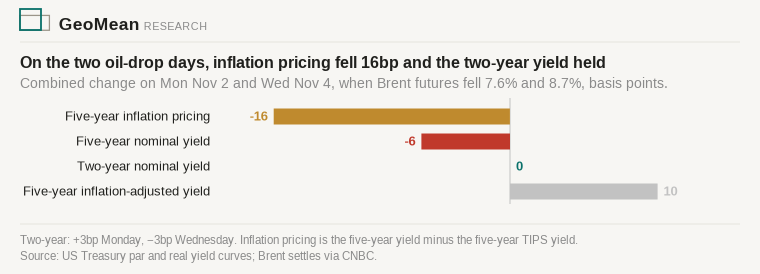
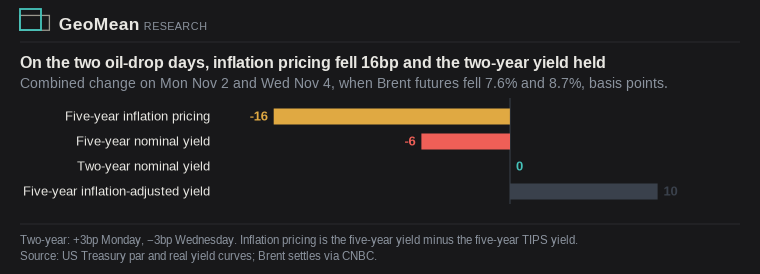
Cheaper oil lowered the inflation bond investors expect, but not the interest rate they expect the Fed to set. On Monday and Wednesday, when Brent fell 7.6 and 8.7 percent, five-year inflation pricing fell 16 basis points while the two-year Treasury yield rose 3 and then fell 3. The Fed’s case for a December increase rests on core inflation, which leaves out energy, and October’s core CPI arrives Tuesday.
Oil-drop days cut inflation pricing, not two-year yields
Brent fell Monday as the US and Iran pursued diplomacy, then 8.7 percent Wednesday to $94.62, its lowest settlement since August 31, after Vice President Vance posted that “the reason we lost is the war,” referring to the midterms, and President Trump told the Financial Times he had no immediate plans to strike Iran (CNBC, CNBC, CNBC). January Brent ended the week at $98.32 (Bloomberg via Rigzone).
Five-year inflation pricing is the gap between the regular and the inflation-protected five-year Treasury yield. It fell 7 basis points Monday and 9 Wednesday, while the regular five-year yield fell 1 and 5 (Treasury). So the inflation-adjusted yield rose 10 basis points as inflation pricing fell 16. The two-year yield, which moves mostly with the rates investors expect the Fed to set, gave back Wednesday what it gained Monday. Futures odds of a December increase stood near 83 percent Wednesday, after both drops, up from 67 percent a week earlier (CNBC, 24/7 Wall St.).
Nasdaq-100’s worst day since 2020 moved credit modestly
The Nasdaq-100 fell 6.36 percent Thursday and the PHLX semiconductor index 12.25 percent (Nasdaq, Nasdaq). The high-yield bond spread, the extra yield on junk bonds over Treasuries, widened 16 basis points to 3.48 percentage points. That was its widest of 2026 but well short of the 59 and 44 basis points it added on April 3 and 4, 2025, the last time the Nasdaq-100 fell more than 5 percent (ICE BofA via FRED).
CNN tied the selloff to Democrats’ wins in states with heavy data-center construction, above all Texas, where Governor-elect Gina Hinojosa campaigned on a temporary moratorium on new data centers (CNN). Those results were known Wednesday, when the Dow rose 3 percent and the chip index fell 3.1. Qualcomm’s Wednesday miss, blamed partly on memory-chip costs, is the only Thursday company news cited.
The two-year yield fell 12 basis points Thursday, and futures odds of a December increase fell as low as 66 percent (Treasury, CNBC).
After payrolls, futures put a December increase at 77 percent
October payrolls rose 165,000 against a 59,000 forecast, August and September were revised up a combined 84,000, and unemployment fell to 4.1 percent from 4.2 (BLS). Futures odds of a December increase rose to 77 percent (CNBC), and the two-year yield rose 5 basis points to 4.51 percent (Treasury). Initial jobless claims were 189,000 in the week to October 31, the lowest since July 18 (DOL via FRED).
Low claims do not settle what Thursday’s selloff means. The Nasdaq-100 has had 30 worse days since 1986, in six episodes. Three came just before or during recessions (2000–01, 2008 and 2020), and three did not (1987, 1997 and 1998). Claims were near their one-year lows at the start of all three not tied to a recession, and also in early 2000, a year before the 2001 recession (FRED NASDAQ100).
Core inflation, not oil, is the Fed’s December test
September’s core CPI rose 0.33 percent against a 0.2 percent forecast (BLS). Separately, the Fed’s September projection of 3.4 percent core PCE inflation for 2026 needs that index to rise about 0.33 percent a month through December. Brent’s drop came after October’s prices were collected, so Tuesday’s report will not show it. Mohamed El-Erian (Allianz) said Thursday that “the market is overdoing it” on AI fears and that he still expects at least one more increase (Yahoo Finance). Friday’s payrolls made that increase more likely in futures pricing, not less.
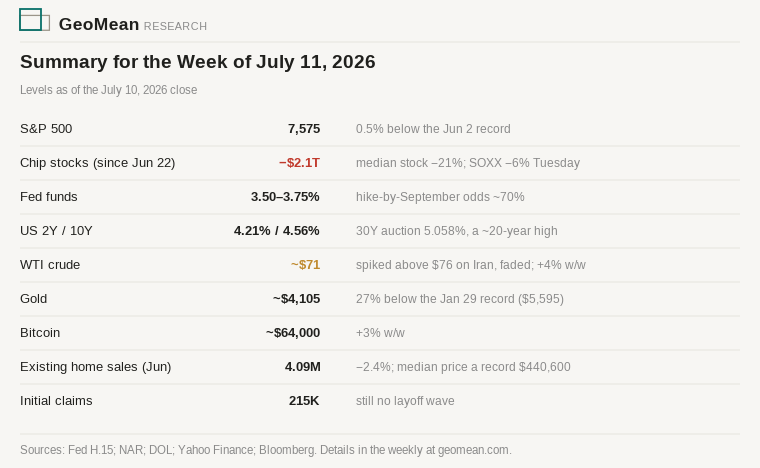
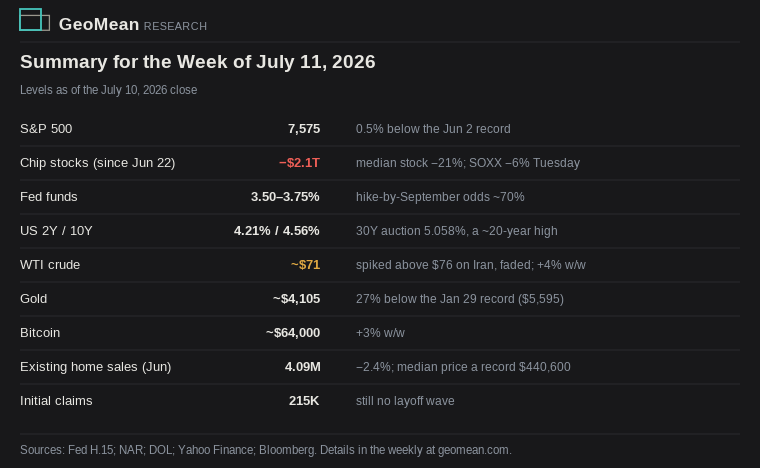
Snapshot
Watching
- Tue Nov 10 — October CPI. The consensus looks for 0.2 percent core, after September’s 0.33 and August’s 0.29.
- Thu Nov 12 — October existing-home sales, the first to include contracts signed after the 30-year rate passed 7 percent; September’s pace was 3.99 million.
- Fri Nov 13 — October PPI. September’s producer prices rose 1.3 percent, energy 10.8 percent (BLS); crude’s November drop lands in next month’s report.
- Tue Nov 17 — October retail sales. September rose 0.8 percent, 71 percent of the added dollars at gas stations.
- Wed Dec 9 — the Fed’s decision and new projections, with an increase priced at about 77 percent.
Sources
Oil: CNBC Nov 2, Nov 4, Nov 5 · Bloomberg via Rigzone, Nov 6 · Rates: Treasury par yield curve · Treasury real yield curve · Fed odds (CME FedWatch as reported): 24/7 Wall St., Nov 7 · CNBC Investing Club, Nov 5 · CNBC, Nov 6 · Stocks: Nasdaq index history (SOX) · Nasdaq index history (NDX) · CNN, Nov 5 · investingLive, Nov 5 · Nasdaq-100 history via FRED NASDAQ100 · Credit: ICE BofA high-yield spread via FRED · Labor: BLS Employment Situation, October · DOL initial claims via FRED · Prices: BLS CPI, September · BLS PPI, September · Snapshot: Cboe VIX history · Freddie Mac weekly rate history · Coinbase BTC-USD daily · Voices: Mohamed El-Erian via Yahoo Finance, Nov 5 · Builds on the October FOMC note (the 0.33 percent monthly path), the October jobs note and the October 31 weekly.