Summary of September JOLTS, November 3, 2026
- Quits rose 321,000 to 3.37 million, a 2.1% rate after 1.9%.
- Restaurants and hotels account for 197,000 of the rise; quits elsewhere rose 124,000.
- Restaurant quits and hires both rose against their usual September decline.
- Openings rose to 7.52 million, above the 7.1 million expected; layoffs were 1.64 million.
Workers quit 3.37 million jobs in September, 321,000 more than in August and the largest one-month rise since May 2023 (BLS JOLTS, Table 4). The quits rate was 2.1%, which BLS calls little changed from 1.9%. It had been at or below 2.0% for 14 months; the 2019 average was 2.3%.
Restaurants and hotels account for most of the rise in quits
Restaurant and hotel quits (accommodation and food services) rose 197,000 to 719,000, a 5.0% rate. Quits in the rest of the economy rose 124,000, across construction, health care, business services and retail, a rate of 1.83% after 1.74%.
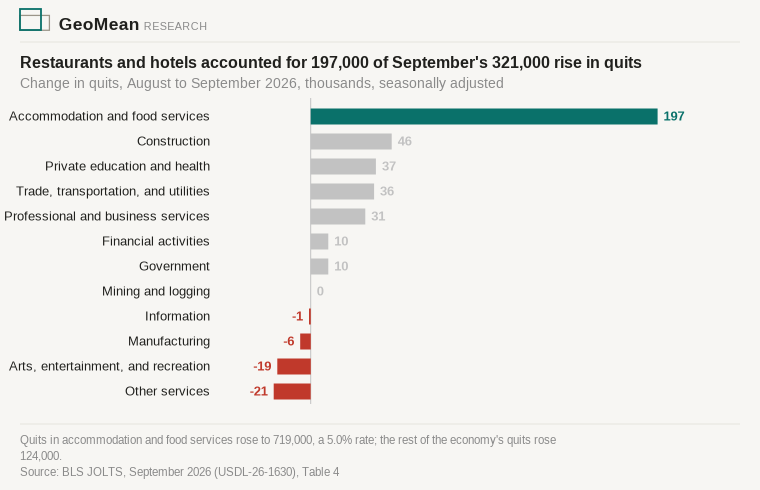
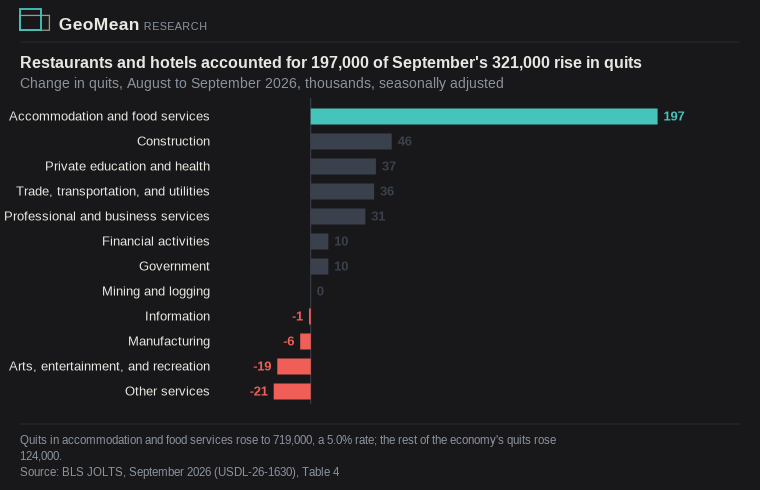
Seasonal adjustment did not create the industry’s rise. Before adjustment, its quits fell from August to September in every year from 2006 to 2025. This year they rose 82,000, the largest rise for that month since the series began in 2001.
Restaurant hiring also rose against the season
Hires in the industry rose 158,000 to 879,000 and total separations rose 195,000 to 883,000, while payrolls grew 7,000 (BLS Employment Situation). Before adjustment, hires rose 105,000 from August to September; the largest such rise from 2001 to 2025 was 18,000.
BLS adjusts JOLTS hires and separations so their difference tracks payrolls, so the matching rise does not show that restaurants filled the jobs that were quit. The release does not say whether turnover rose or the September sample was unusual.
Openings beat expectations and layoffs eased
Openings rose 333,000 to 7.52 million (August revised up 111,000), which BLS calls little changed. Openings in state and local government outside education rose 104,000, the only industry increase BLS flagged. Openings per unemployed worker were 1.06, from 1.02.
Layoffs and discharges were 1.64 million, the fewest since March 2025 and, per BLS, little changed. August’s figure was revised up 127,000 to 1.77 million. Weekly jobless claims were 194,000–200,000 from September 12 to October 24 (Labor Department).
All of the decline was at establishments with fewer than 10 employees, where layoffs fell 145,000 to 120,000, the lowest since March 2022. Openings there rose 155,000 to 1.39 million, their June and July level; their August decline was revised to 152,000 from 335,000.
Of the totals, only quits rose significantly
The Fed held rates at 3.75–4% on October 28, with two officials voting to raise. Openings, quits and layoffs all moved toward a tighter labor market, but of the totals BLS judged only the quits rise significant, 61% of it in one industry. October payrolls arrive November 6, October JOLTS on December 1, and the Fed meets December 9.
Sources: BLS Job Openings and Labor Turnover Survey, September 2026 (USDL-26-1630) — levels and rates, the August revisions, Table 4 industry quits, Table 7 establishment-size detail, and the technical note on alignment. Industry and size-class history, seasonally adjusted and not, from the BLS public data API (series JTS720000000000000QUL, JTU720000000000000QUL, JTU720000000000000HIL, JTS100000000000001LDL and related), 2001–2026. Payroll employment from the BLS Employment Situation, September 2026 (CES0000000001, CES7072000001), and unemployed workers from the same release. Initial claims: Labor Department weekly unemployment insurance claims, seasonally adjusted, archived with this piece. Consensus is the market’s expectation before the release. The 2019 average, the streaks and the lowest- and largest-since comparisons are counted from series archived with this piece. Builds on the August JOLTS note and the October FOMC note.