Summary of October ISM Manufacturing, November 2, 2026
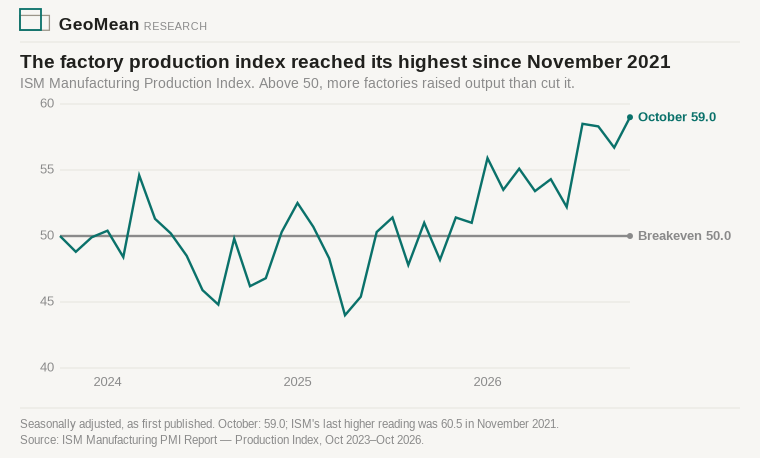
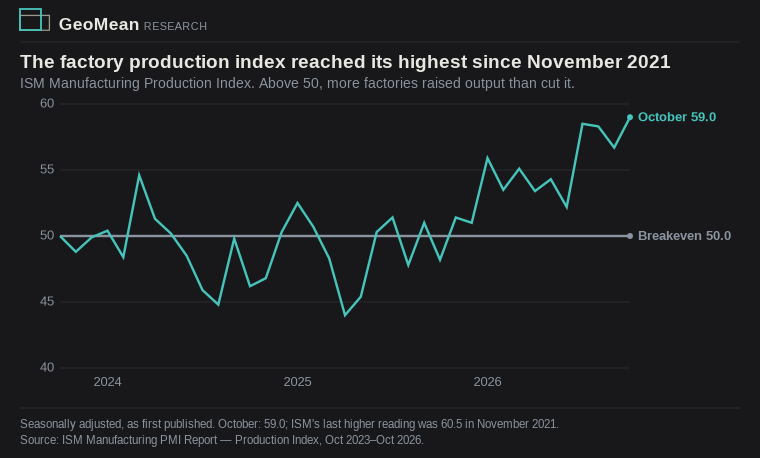
- ISM’s production index rose 2.3 points to 59.0, its highest since November 2021.
- Production and inventories account for all of the 1-point rise in ISM’s overall index, to 55.5.
- The Fed measured third-quarter factory output up at a 0.7% rate, all of it from durable manufacturing.
- 53.1% of factories paid more for materials, down from 58.6%.
Production and inventories account for the overall index’s rise
In October 27.6% of factories made more and 11.5% made less (ISM, October report), taking the production index to 59.0 from 56.7, its highest since 60.5 in November 2021. Seasonal adjustment added about 1 of the 2.3 points; before adjustment the index rose 1.3 to 58.1, the highest since at least October 2023.
Production and inventories (51.4 from 48.6) account for all of the overall index’s rise to 55.5 from 54.5; employment slipped 0.3 to 52.4, though before adjustment the share of factories cutting jobs fell to 10.8% from 14.5%. Two-thirds of comments were negative, chiefly on pricing volatility (62% of negatives) and longer lead times (41%); comments on output ran 2 to 1 positive.
Third-quarter factory output grew slowly as nondurables shrank
The production index averaged 57.8 in the third quarter, while the Federal Reserve measured manufacturing output growing at a 0.7% annual rate (Fed G.17, October 16). Durable manufacturing output grew at a 3.8% rate, “driven in part by” a 28.4% annualized rise in semiconductors; nondurables fell at a 1.6% rate. More factories reported gains than declines even as nondurable output shrank. ISM’s own threshold for rising Fed output is 52. October’s Fed figures arrive November 17.
Fewer factories paid more for materials after oil’s September jump
The share of factories paying more fell 5.5 points to 53.1%; the prices index fell 2.7 to 75.2, its ninth month at or above 70. Sixteen of 18 industries paid more; none paid less. Brent averaged $125 a barrel through October 27, 9% above September’s average, but most of that rise came within September: it climbed from $96 on September 1 to $131 on September 15, and October averaged about 4% above September 15–30 (EIA).
Petroleum and coal products, top of September’s list of industries paying more, were not on October’s. Nickel, zinc and plastic-based products dropped off the list of materials rising in price. Polypropylene resin was reported falling, and some buyers reported aluminum falling while others reported it rising; none were reported falling in September. Tariffs came up in 25% of negative comments, down from 34%, and the Iran war in 21%, down from 30%.
September’s producer costs rose most early in the chain
ISM ties its prices index to producer prices for intermediate materials. In September, when 58.6% of factories paid more, stage 2 inputs rose 3.9% while stages 3 and 4, closest to final demand, rose 1.1% (September PPI note). October’s PPI arrives November 13.
Sources: ISM, October 2026 Manufacturing PMI Report — PMI 55.5; sub-indexes, higher/same/lower tables, industry and commodity lists, comment shares (release text and page archived); unadjusted readings computed from ISM’s response tables, archived from each monthly release since October 2023; September comparisons from the September report. Factory output: Federal Reserve Board, G.17 Industrial Production and Capacity Utilization, October 16, 2026 (archived). Brent: EIA, Europe Brent spot price FOB, daily prices through October 27 (pulled via FRED series DCOILBRENTEU), archived. Builds on the September ISM note and the September PPI note. ISM is a diffusion index (50 = breakeven) and proprietary, not on FRED; the prices index is not seasonally adjusted.