Summary of the Q3 2026 GDP advance estimate, October 29, 2026
- Real GDP grew 3.4 percent at an annual rate, from 2.2; the Atlanta Fed’s final GDPNow estimate was 3.3.
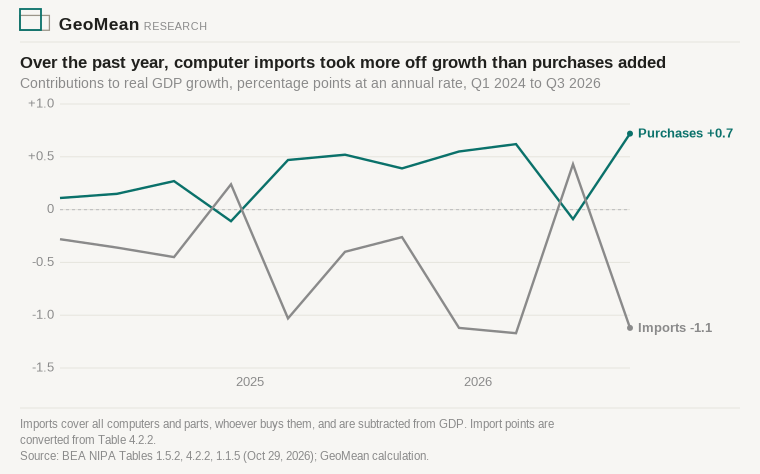
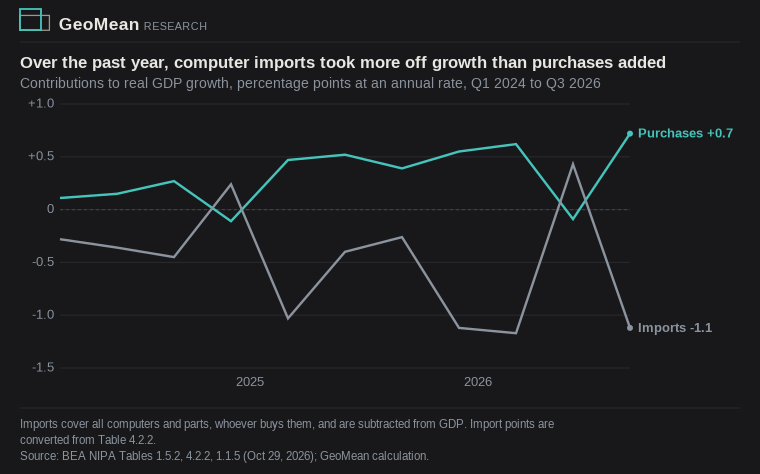
- Business purchases of computers added 0.72 percentage point, the most in BEA’s records back to 1959.
- Computer imports took about 1.1 points off; they have outweighed purchases in seven of the last 11 quarters.
- Outside computers, private demand grew about 4.1 percent, above 4 for a second quarter.
| Contributions to growth (points) | Q3 2026 | Q2 2026 |
|---|---|---|
| Consumer spending | +2.52 | +2.51 |
| Business and housing investment | +1.66 | +1.35 |
| — of which computers and peripherals | +0.72 | −0.09 |
| Inventories | +1.61 | −0.53 |
| Exports | −0.68 | +0.56 |
| Imports | −2.64 | −1.66 |
| — of which computers and parts (approx.) | −1.1 | +0.4 |
| Government | +0.90 | −0.01 |
| Real GDP, % change | 3.4 | 2.2 |
| Private demand, % change | 4.9 | 4.6 |
| Nominal GDP / GDP price index, % change | 5.6 / 2.3 | 8.5 / 6.1 |
Computer imports subtracted more than computer investment added
GDP counts only what is produced in the United States, so imports are subtracted. Imports grew 19.7 percent; computers, peripherals and parts supplied 8.4 points of that, about 1.1 points of GDP growth. Business computer purchases added 0.72. BEA estimated that investment mainly from import data; the import figure also covers parts and computers others bought or stocked, which BEA does not separate.
Over the past four quarters, business computer purchases added an average 0.45 point a quarter and computer imports subtracted about 0.74.
Outside computers, private demand stayed above 4 percent
Private demand, consumer spending plus business and housing investment, grew 4.9 percent, the fastest since the second quarter of 2021. Without computers it grew about 4.1 percent, a second quarter above 4 after rates between 1.1 and 2.7 in the four quarters before.
Inventories and government added 2.5 points to growth
Businesses went from cutting inventories at a $63 billion annual rate (2017 dollars) to adding $20 billion, led by nondurable-goods wholesalers and manufacturers. Growth counts the change in that pace, so a steady $20 billion build would add nothing in the fourth quarter.
Government added 0.9 point, 0.49 of it from nondefense federal spending, which BEA attributes mainly to smaller sales from the Strategic Petroleum Reserve. BEA deducts those sales from government spending and counts the oil where it is bought, so the change has no direct effect on GDP; the release does not say which components carry the offset.
Households spent faster than their income grew
Real consumer spending grew 3.8 percent and real after-tax income 2.3, so the quarter’s saving rate fell to 4.1 percent from 4.4.
Sources: BEA, GDP (Advance Estimate), 3rd Quarter 2026 (BEA 26–45) and its release PDF, both archived. NIPA Tables 1.1.1, 1.1.2, 1.1.5, 1.1.6, 1.1.7, 1.4.1, 1.5.2, 2.1 and 4.2.2 as published October 29, 2026; the computer contribution’s rank is from Table 1.5.2, which begins in 1959. Computer imports in points of GDP growth are converted from Table 4.2.2’s contributions to import growth; private demand without computers is approximate, from Table 1.5.2 contributions. Both calculations and their scripts are archived with this piece. Nowcast: Federal Reserve Bank of Atlanta, GDPNow commentary, October 28, 2026, archived. Quarterly figures are seasonally adjusted annual rates.