Summary of the October 2026 FOMC decision, October 28, 2026
- The Fed held at 3.75–4 percent, 10–2; Governor Lisa Cook and Cleveland Fed President Beth Hammack wanted a quarter-point increase (statement).
- Futures put a December increase at about 85 percent, about where they stood Tuesday (Bloomberg data via Yahoo Finance).
- Reaching the Fed’s September inflation projection would take core PCE prices rising about twice their summer pace.
Ten officials voted to wait for more information
September’s statement said that day’s increase would “support a timelier return” to 2 percent. Wednesday’s says instead that “the accumulation of more information will help the Committee determine the policy stance appropriate.” The committee also upgraded growth to “a strong pace” from “a solid pace.”
Chair Kevin Warsh said the committee judged its “monetary medicine” to be “starting to work some, but there’s no firm conclusions” (Yahoo Finance). “Most participants” judged another increase “would likely be appropriate by year end,” the September minutes say (Fed).
Two-year yields fell 3 basis points and the 30-year rose 7
Futures put a hold at 93 percent beforehand (CME FedWatch via CNN). The two-year Treasury yield closed at 4.67 percent, the 30-year at 5.37 (Treasury). Five of the 30-year’s 7 came from the inflation-adjusted yield, so the inflation priced into the 30-year barely changed (Treasury). After July’s hold the two-year fell 4 and the 30-year rose 11; after September’s increase the two-year rose 7 and the 30-year fell 1.
Reaching the Fed’s forecast takes twice summer’s core inflation pace
The September median put 2026 core PCE inflation at 3.4 percent, fourth quarter to fourth quarter (projections). Two weeks later BEA restated the series lower (our August PCE note). On the restated figures, reaching 3.4 would take core prices rising about 0.33 percent a month from September through December; from June to August they rose 0.17 (BEA).
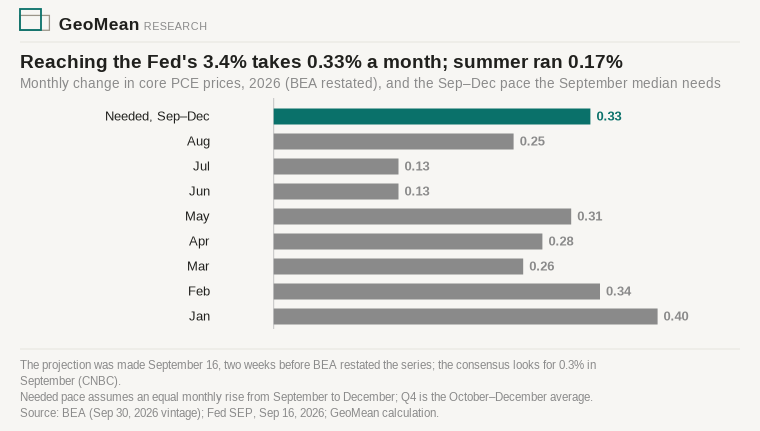
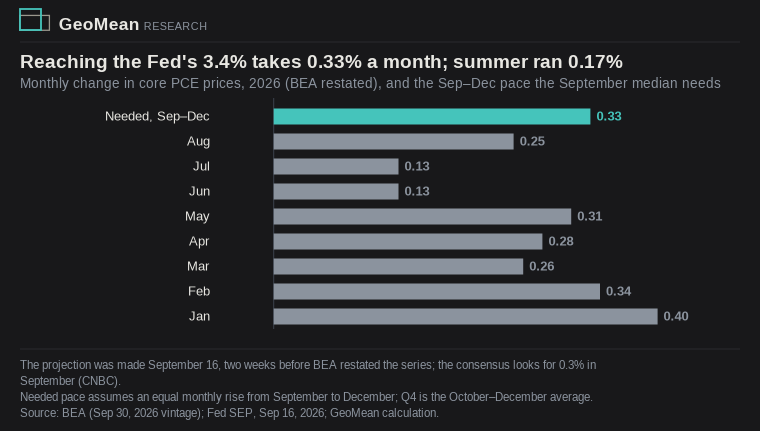
The consensus looks for 0.3 in Thursday’s September PCE report (CNBC). At 0.3, reaching 3.4 would take about 0.35 in each of October, November and December.
Cook’s first dissent favored higher rates as the White House seeks her removal
President Trump has called for lower rates, and a White House committee holds a hearing on allegations against Cook November 5 (CNN, Oct 9 and Oct 28). Michael Feroli (JPMorgan) asked why the Fed raised rates after a 0.2 core PCE reading and would hold after an expected 0.3 (CNBC). Warsh said “politics played no role in the decision,” six days before the midterms. Governor Christopher Waller had said October 8 that increases “do not need to come at consecutive meetings” (Fed), floating a skipped meeting in advance. December 9, the first meeting after the election, is the test.
From 2027 the Fed will set rates at fewer meetings
Seven of next year’s eight meetings will set rates, and Warsh expects six in 2028; the others are for “thinking anew about big questions” (opening statement).
Sources
FOMC statement, Oct 28 and implementation note · Sep 16 statement · Jul 29 statement · September minutes · Summary of Economic Projections, Sep 16 · Press-conference opening statement, preliminary · Waller, Oct 8 · BEA, August personal income and outlays · Treasury par yield curve, 2026 CSV · Treasury real yield curve, 2026 CSV · Live coverage: CNN, CNBC, Yahoo Finance · CNN on the Cook committee, Oct 9 · Builds on the September FOMC note, the August PCE note and the September CPI note.