Summary for the Week of August 21, 2026
- Treasury will at least double the cap on its liquidity-support buybacks of 10-to-30-year bonds, from $2 billion to at least $4 billion per operation, effective September 9 through November 4 (Treasury).
- Thirty-year yields fell nine basis points to 5.19% on the announcement, then closed the week at 5.27%, above the 5.25% they started from; Monday’s 5.31% was their highest close since June 2007 (Treasury daily curve).
- The July FOMC minutes, out hours later, recorded that “many participants assessed that policy tightening would likely be necessary if inflation did not decline” (Federal Reserve).
- Gold rose to about $4,600 and Bitcoin 24%, its best week since March 2023, while the S&P 500 fell 1.4% (Kitco).
Two arms of the government moved in opposite directions on Wednesday: in the morning the Treasury said it would buy more long-dated bonds than planned; in the afternoon the Federal Reserve published minutes showing a committee that thought it might have to raise short rates. Neither was a response to the other, and by Friday neither had left a mark — the week’s yield moves came from the activity data and oil. The 30-year ended the week higher than it began.
Treasury moved off its own schedule to buy long bonds
Treasury sets buyback sizes at the quarterly refunding; it had published this quarter’s schedule two weeks earlier, then overrode it. The $2 billion cap had held in all 49 of the program’s 10-to-30-year operations since May 2024. The larger ones do not begin until September 9, and Treasury did not say how it will fund them — paying with bill issuance would shorten the debt’s average maturity, not reduce the debt.
Treasury’s stated reason is liquidity support — buying older, less-traded bonds where it sees “consistent strong sponsorship” — not lower yields. And the sums are small: $2 billion more per operation, against $32.3 trillion of federal debt held by the public (Treasury).
In July 2024 Stephen Miran and Nouriel Roubini, both then at Hudson Bay Capital, criticized what they called activist Treasury issuance, warning it would be “used repeatedly by all future administrations” (paper). Bloomberg has reported that Treasury Secretary Scott Bessent was among the Republicans who called Yellen’s 2023 issuance shift politically motivated (Fortune). Whether this is the larger version turns on the funding, which Treasury has not disclosed.
Strong factory surveys and costlier oil erased the drop
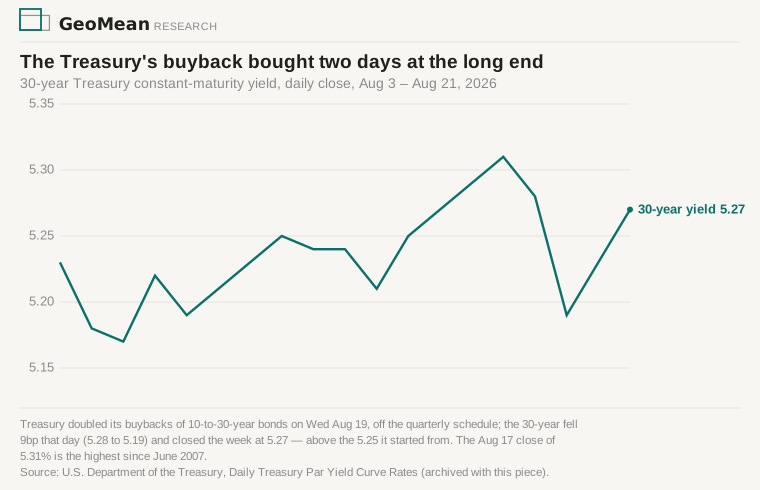
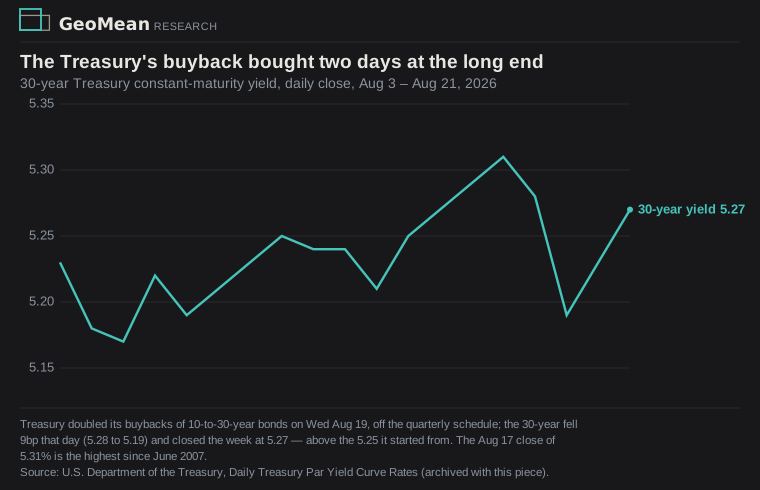
Yields rose again on Thursday and Friday. The Philadelphia Fed’s factory index hit its highest since April 2021, and Friday’s purchasing-managers survey showed activity accelerating. Brent crude rose after the 60-day US–Iran understanding on Hormuz transit expired on Monday with no deal to replace it. Two-year yields, which track the Fed rather than the debt stock, rose seven basis points — five on Friday, after the survey.
July’s minutes are more hawkish than the 9–3 hold
A vote records the decision; the minutes record the spread of views behind it, and this spread runs hawkish. Several participants wanted a quarter-point increase in July; a few argued that moving then “would likely help forestall the need for a steeper and potentially more costly sequence of tightening moves at a later stage.” Participants judged inflation risks “skewed to the upside.” No Fed governor spoke publicly between August 6 and August 22, so the minutes were the Board’s only voice that week.
At the July meeting, the minutes note, the market “was fully pricing in a 25 basis point hike by the September meeting”; after two soft inflation reports and a negative payroll month, it now prices roughly a third of one, and the minutes did not change it (Reuters).
The 30-year’s rise was inflation compensation, not real yields
The 30-year’s inflation-protected yield fell from 3.00% on August 14 to 2.95% on August 20 while its nominal yield rose. The gap between the two is what investors will pay for protection from inflation, and it widened; five-year inflation compensation reached a two-month high.
That makes the rest of the week coherent without a claim about the dollar: gold and silver rose as real yields fell, and Thursday’s inflation-protected auction drew unusually strong demand.
Three people who watched the same announcement read it three ways. Luke Gromen (FFTT) calls it “a soft form of yield curve control” that Treasury “has to” run, whose trade-off “is that it’s going to be inflationary”; Bill Fleckenstein (Fleckenstein Capital) calls it “really kind of a non-event… a signaling move”; Joseph Wang (Fed Guy), who concedes the attempt “so far has not been successful,” argues Treasury has tools enough to bring long yields down eventually. Watch whether the September 9 operations move yields once they actually begin.
Snapshot
Watching
- Tue Aug 25 — July new-home sales, 10:00 ET. Ten-plus months of unsold supply, and single-family starts at their lowest since November 2022.
- Wed Aug 26 — July PCE, Q2 GDP second estimate, durable goods, 8:30 ET. Core PCE at 3.3% against core CPI’s 2.5%; forecasters look for 0.2% on the month.
- Fri Aug 28 — Warsh at Jackson Hole, and the payroll benchmark at 10:00 ET. His first symposium as chair; the Kansas City Fed’s stated theme is “Financial Innovation: Implications for Payments and Policy.” Last year’s preliminary benchmark revision was −911,000.
- Wed Sep 9 — the larger buybacks begin. The first test of whether the operations do what the announcement briefly did.
- Iran. Bessent’s sanctions against a de-escalation signal from President Pezeshkian; oil’s rise reverses on talks and extends on a blockade.
Sources
Data: Treasury buyback announcement · Treasury daily yield curve · July FOMC minutes · Philadelphia Fed manufacturing survey · Kansas City Fed symposium · markets: CNBC on the buyback, CNBC on analyst reaction, Kitco, CNBC on Bitcoin, Reuters · oil: Al Jazeera. Voices: Luke Gromen on Monetary Matters · Bill Fleckenstein on Thoughtful Money · Joseph Wang, Markets Weekly Aug 22. Builds on the August 17 weekly. Figures verified and archived in the GeoMean data files.