Summary for the Week of August 14, 2026
- September hike odds fell from about 55% after Monday’s oil spike to 42% on the inflation report and roughly 30% by the weekend (CNBC; Mohamed El-Erian).
- Thursday’s $25 billion 30-year auction stopped at 5.216% — no 30-year auction had paid more since 2001 (results).
- July retail sales fell 0.6% against a consensus near +0.1%; the control group fell 0.5%, its largest drop since January 2025 (Bloomberg).
- WTI rose about 5% to $82.40 as the Hormuz talks broke down over Iran’s reparations demand and the UAE said Iran attacked two of its tankers (CNBC).
- The New York Fed will make no reserve-management purchases through mid-September — the first pause since the program began (NY Fed).
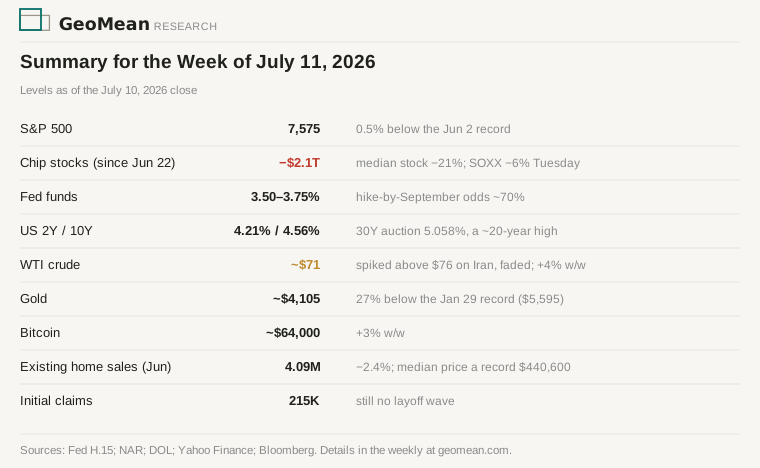
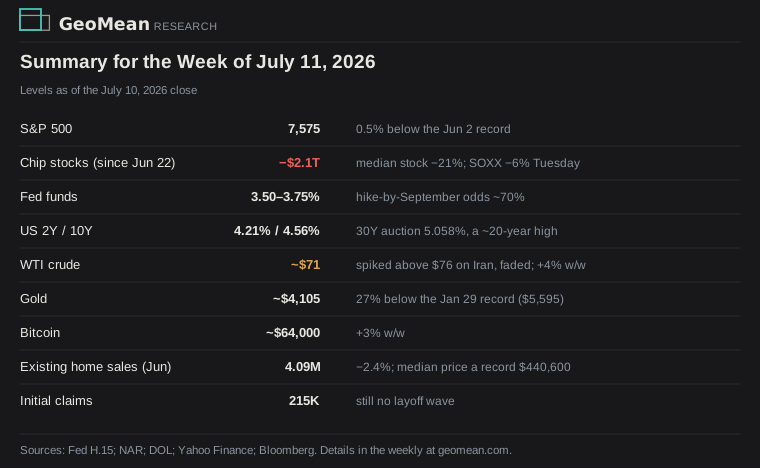
The case for a September hike came apart in stages — the smallest 12-month core CPI rise since February on Wednesday, flat producer prices Thursday, falling retail sales Friday. Thirty-year yields didn’t fall with it: two-year yields ended the week two basis points lower, the 30-year six higher, and Friday’s 5.25% close (Treasury) sits two basis points under the July 31 peak. Short-maturity investors spent the week repricing a meeting. Long-maturity investors were pricing a Fed that won’t say how it decides — and no meeting settles that.
Oil rebuilt the case for a hike on Monday; three reports dismantled it by Friday
The week’s only inflationary news came first. Iran conditioned the Hormuz reopening on sanctions relief and war reparations (Al Jazeera), attacks on shipping resumed — the UAE said Iran struck two of its state oil company’s tankers in the strait — and Treasury Secretary Bessent threatened “economic isolation” (CNBC). Crude gave back most of the prior week’s decline, and hike odds briefly reached about 55%.
Then three reports reversed it: core CPI at 2.5% (the July CPI note), producer prices unchanged (the July PPI note), and a retail sales decline that reached the control group feeding GDP. Citi’s out-of-consensus call from the week before — unemployment above 4.5% within months, three cuts by January — reads closer to the middle now (CNBC).
Consumers read the same week differently. The Michigan survey’s preliminary August index fell to 51.0, and respondents raised their one-year inflation expectation to 4.3% — well above February’s pre-war 3.4%, the survey notes (Surveys of Consumers). The gasoline in their tanks, not the CPI table.
Long-maturity investors have stopped trading the monthly inflation numbers
The auction was orderly and expensive: bid-to-cover 2.39, a 0.4 basis-point tail, dealers left with 11.5%. That is not a failed sale — and by Joseph Wang’s (Fed Guy) read not a supply problem either: swap spreads, which would sink if dealers were choking on issuance, have been stable for months (Markets Weekly). It is the price investors now charge to hold 30-year risk, even in a week of slowing inflation.
Wang notes that every data-driven dip in yields this week “immediately retraced.” His explanation: Chair Warsh won’t say how the Fed decides — no published reaction function — and has floated revisiting the inflation target, so investors charge for the uncertainty.
Jim Bianco (Bianco Research) reads the same retrace and prescribes the opposite: “if they raised rates, I think long-term yields would come down, not go up” (interview) — a hike as proof the committee still fears inflation. The two split on what the 30-year is pricing: for Wang, uncertainty about how this Fed will react, charged as term premium; for Bianco, inflation itself, feared precisely because the committee won’t move against it. Lacy Hunt (Hoisington Investment Management), after four decades arguing the opposite, now writes that equilibrium inflation has moved to 3.5–4.5% with long-maturity yields trending upward absent a recession — a measure of how far this repricing has run.
The Fed’s bill purchases went to zero the same week the hike came out of the price
The New York Fed will make no reserve-management purchases through September 14 — the program’s first zero month since it began in December 2025, after tapering from $40 billion a month at the start to $10 billion since May (NY Fed). The purchases are Treasury bills, bought to keep bank reserves ample — they do not touch the 30-year directly, and the Desk calls the amounts technical and “not on a preset course.”
Still: a $10 billion monthly Treasury bid went to zero in the same week September hike odds fell by nearly half. Whether it resumes on the September schedule, published before the meeting, is worth watching.
Gold held above $4,400 all week and silver crossed $66 (Yahoo Finance). Every event below lands before the September 15–16 meeting; two land on the same morning.
Snapshot
Watching
- Wed Aug 19 — July FOMC minutes, 2:00 ET. The first minutes of the three-dissent meeting: how close the committee actually was to hiking.
- Tue Aug 26 — July PCE, Q2 GDP second estimate, durable goods. Core PCE at 3.3% is the number the dissenters cite; the CPI–PCE gap is the live question after core CPI’s 2.5%.
- Fri Aug 28 — Jackson Hole and the payroll benchmark, same morning. Warsh’s first symposium as chair (Aug 27–29); at 10:00 ET Friday, BLS publishes the preliminary benchmark revision (schedule) — last year’s preliminary was −911,000 (revision history).
- Fri Sep 4 — August jobs. The last employment report before the meeting, carrying July’s −23,000 with it.
- Hormuz. Reparations are the sticking point and tankers are being hit; WTI’s 5% week reverses on a deal, extends on a blockade.
Sources
Data: BLS CPI (archived) · BLS PPI (archived) · Treasury 30-year auction results and the TreasuryDirect auction-history series (archived — verifies “highest since 2001”) · Treasury daily yield curve · NY Fed operational details · BLS CES benchmark schedule and revision history · Surveys of Consumers, August preliminary · Jackson Hole dates (KC Fed) · retail sales: Bloomberg, control group recounted from the Census series (archived) · Fed pricing: CNBC, CNBC on Citi · oil: CNBC, Al Jazeera · markets: Yahoo Finance. Voices: Joseph Wang, Markets Weekly Aug 15 · Jim Bianco · Mohamed El-Erian, Weekly Look Aug 16 · Hoisington Q2 letter (archived in the GeoMean data files). Builds on the July CPI note, the July PPI note, and the August 8 weekly. Figures verified and archived in the GeoMean data files.