Summary for the Week of August 1, 2026
- The Fed held 9–3 Wednesday; the market-implied probability of a September hike fell from about 82% at the start of the week to roughly 60%, nearly all of it in the hours after the decision — before any of Thursday’s data (Bloomberg; Wednesday-afternoon snapshots ranged to the mid-50s per the July FOMC note).
- Core PCE rose 0.1% in June (BEA) — the softest month since March 2025, 2.9% annualized over three months (GeoMean calculations from BEA’s core index); Q2 GDP came in at 1.5% against a ~2.1% consensus, with imports and inventories accounting for the shortfall (BEA, Fox Business).
- The 30-year Treasury closed Friday at 5.27% — the highest since July 6, 2007 — rising through the soft data (Treasury).
- The S&P rose 1.05%: Microsoft’s ~$450 billion Thursday was reported as the largest one-day value addition on record (CNBC coverage); Meta fell 8% on a raised capex guide and $784 million of free cash flow (CNBC).
- Japan spent an estimated ¥8.45 trillion (~$53B) buying yen Thursday (Bloomberg); the US Treasury followed Friday (FT reporting) — the first joint yen operation in roughly three decades, framed as countering a disorderly yen slide; why Washington judged that worth its own reserves is genuinely unclear from the reporting. The move mostly retraced anyway.
Three things happened this week that look connected and mostly aren’t. The probability of a September hike fell — because the Fed held, not because of the data. Stocks recovered — on earnings, led by Microsoft’s record day. And 30-year Treasury yields rose to their highest close since July 2007 — not because of anything in the data, but because buyers of long Treasuries keep demanding more yield, and the chair has begun asking, in his own printed words, “how much accommodation are we getting from the balance sheet?” (press conference transcript). A market that once assumed the Fed would absorb long-maturity supply is being told, gently, to check that assumption.
Wednesday’s hold did the repricing; Thursday’s data barely moved it
Thursday gave the doves their best data morning in months — core PCE at 0.1% for June, 2.9% annualized over three months, and GDP at 1.5% — and the September probability barely moved — investors had already repriced on the decision. The growth miss was not as bad as it looked: imports subtracted 1.5 points and inventories 0.7, while real final sales to private domestic purchasers grew 3.9%, up from 1.7% in the first quarter — the domestic engine is not the problem (BEA tables). Then Friday undid the dovish drift: the employment cost index rose 0.9% against a 0.8% consensus (BLS), and all three dissenters published their reasoning — Lorie Logan (Dallas Fed): “monetary policy is not restraining the economy” (Dallas Fed). Wage costs running above forecast plus three public cases for a hike is why yields rose into the weekend rather than falling on the soft Thursday.
Investors are pricing a Fed that steps back from the long-maturity market
Investors began doubting, mid-press-conference, that Warsh will deliver the hikes they had priced — long-maturity yields and stocks turned together while he was still speaking. What that turn meant is disputed. One reading calls it a credibility shock: a chair who talks about price stability but won’t act. The other takes him literally: he wants the Fed’s balance sheet out of the business of subsidizing long-maturity yields, and the selloff is that policy taking effect (Quinn Thompson argues this on the Forward Guidance roundup; Jeffrey Gundlach took the other side on CNBC, reading the selloff as “bond market vigilantes” demanding action). Decision-day trading leaned toward the literal reading — breakevens fell that afternoon while real yields rose (FRED T5YIE, DFII5), the signature of deliberate tightening rather than credibility failure — though one afternoon settles nothing, and breakevens were near flat on the week. Auctions priced the transition either way: Monday’s $70 billion 5-year note cleared 0.9 basis points above pre-auction trading — a tail — with the weakest bid-to-cover ratio since September 2022 (auction results via Newsquawk).
The AI trade’s leverage era ended; the earnings verdict got finer
Situational Awareness — the multibillion-dollar AI fund run at up to 400% reported leverage — was forced to sell its public book to Citadel, its assets falling toward $10 billion (Bloomberg, CNBC); the semiconductor index finished July down 21.3%, the worst month since December 2002 (Yahoo Finance), then snapped back 8.2% Thursday once the forced seller was out. Earnings refined the capex verdict: investors no longer punish AI spending as a category — they price the proof behind it. Microsoft held its capex guide flat, showed Azure at +43%, and gained roughly $450 billion in a day; Amazon raised capex and rose 15% on AWS’s fastest growth in 18 quarters (CNBC); Meta raised its guide with free cash flow near zero and fell 8%.
Japan defended its currency against the same repricing
The yen’s Thursday surge cost Japan an estimated ¥8.45 trillion, and even with the US Treasury’s follow-on purchases Friday it mostly retraced, after the Bank of Japan held at 1.0% (8–1) under a government that prefers it hold (BOJ, CNBC). A country defending its exchange rate against widening rate differentials is fighting the same repricing the 30-year expresses — and intervention without a policy change bought one day.
There is no Fed meeting in August; the next arguments arrive as data — jobs Friday, CPI on the 12th — then at Jackson Hole, where the chair gets a full address to say what he meant. Three dissents, 60% September odds, and a 30-year at 2007 levels make one point from three directions: the price of money past the Fed’s reach is being renegotiated in public.
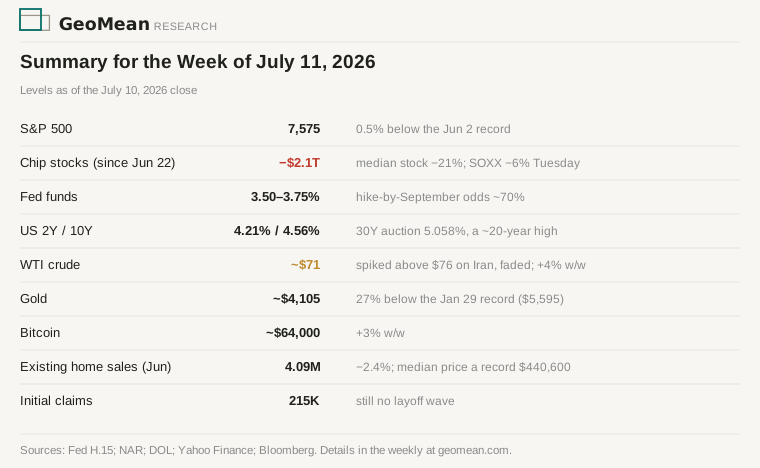
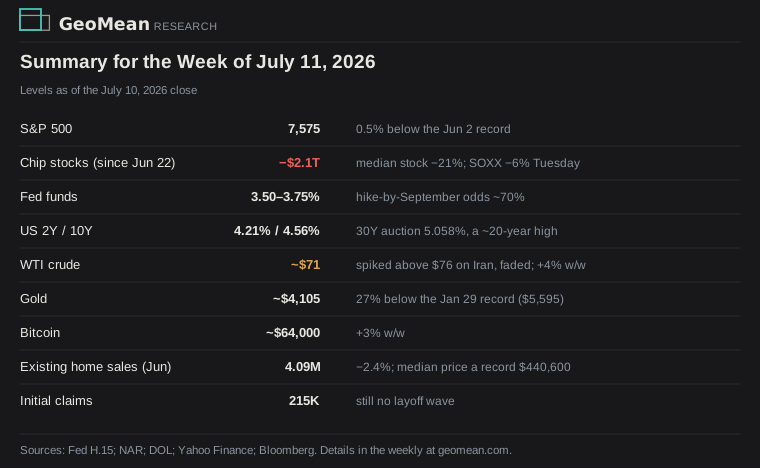
Snapshot
Watching
- Aug 2 — OPEC+. Expected to complete the voluntary-cut unwind (~188K b/d for September) — quota increases against a Hormuz where escorted tankers were struck Friday.
- Aug 5 — Treasury quarterly refunding. The first coupon-size decision priced by a 5.27% 30-year and a fourteenth straight 5-year tail.
- Aug 7 — July jobs. Claims near 1969 lows say tight; the committee’s doves need it to say otherwise.
- Aug 12 — July CPI. The first read on whether $85–90 crude reached anything beyond gasoline; core at 0.0–0.1% would extend the dove case into September.
- Late Aug — Jackson Hole. The balance-sheet question, at essay length.
- Sep 15–16 — FOMC. ~60% priced; three dissenters on the record; two CPIs and two jobs reports between here and there.
Sources
Data: BEA GDP advance · BEA June PCE · Treasury daily yield curve, 2026 · BLS ECI (archived) · Warsh press-conference transcript · BOJ statement · markets: Bloomberg Fed pricing, Bloomberg yen intervention, CNBC Amazon, CNBC chips, CNBC oil Jul 31, Axios dissenters. Voices: Forward Guidance roundup, Jul 30 · Joseph Wang, Markets Weekly Aug 1 · Crowded Market Report, Jul 29 · The Real Investment Show, Jul 31. Builds on the July FOMC note and the July 25 weekly. Figures for this piece are archived in the GeoMean data files.