June 7, 2026
Stocks, crypto, and gold fell together — the signature of a discount-rate repricing, not a growth scare — and it leaves every risk asset riding on Wednesday’s CPI.
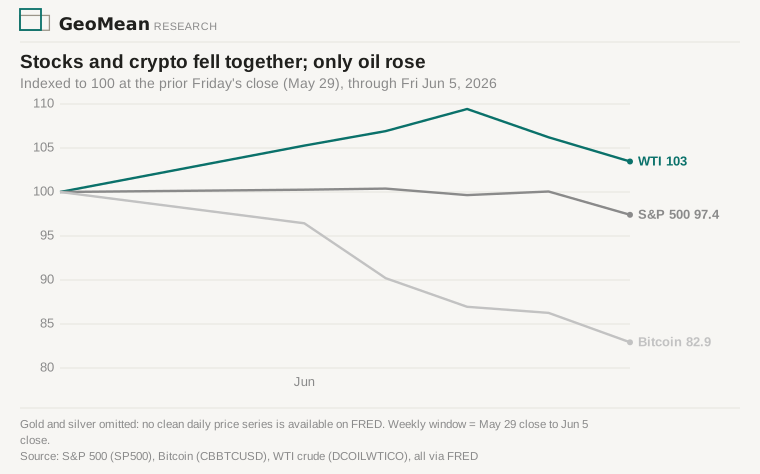
A single jobs print well above consensus broke a ten-week rally, and the way it broke matters more than the drop. Stocks, Bitcoin, gold, and silver fell together on Friday — and when those four move as one, it rules out every comfortable explanation: not a growth scare, not a crypto unwind, not a gold position blowing out. It was the cost of money getting repriced, and everything is priced off the cost of money. Stocks, crypto, and the metals are now trading as a single rate-sensitive instrument, which means the next two weeks come down to one number.
A repricing leaves no safe asset; a growth scare does
A growth scare sends money into Treasuries; this didn’t — the 10Y barely moved and the 30Y pressed toward 5%. A crypto-specific selloff leaves gold alone; gold made a 2026 low. The only factor that hits stocks, crypto, and metals in the same session is the discount rate, and 172,000 payrolls — well above consensus — is what moved it, by taking the Fed’s rate-cut option off the table and putting a hike back on it.
That distinction is the whole question for buyers. A fundamental dip gets bought because the thing that sold off is still worth owning; a discount-rate repricing doesn’t, because nothing broke — the discount rate moved, and it only moves back on data, not sentiment. So the dip-buyers stepping in here are fighting the actual mechanism. This either extends or reverses on Wednesday. It will not be talked back up.
Everything hinges on Wednesday’s CPI
Consensus looks for 4.2% headline and 2.9% core, up from 3.8% and 2.8% — the market is already positioned for an above-consensus print, which raises the bar for a below-consensus surprise and lowers it for an above-consensus one. The two readings of the selloff resolve on Wednesday’s number.
David Cervantes (Pinebrook Capital) argues the labor market is too strong and inflation too broad for anything but hikes — and his “no cuts in 2026” call from March has aged well as every cut got priced out, so the hike case carries weight, not just conviction. Lance Roberts (RIA Advisors) argues the mirror image: a 5–7% rotation rather than a crash, semiconductors falling while value holds, disinflation resuming into year-end. Both can’t be right past Wednesday.
The data leans Cervantes’s way into the print — sticky core, firm average hourly earnings in the jobs report, a yield curve flattening the way it does when short-term yields rise in anticipation of tightening. A headline print above 4% confirms the repricing, and Friday was the first move, not the last. A sub-4 surprise validates Roberts, and the selloff was the opportunity. It’s binary and two days out; pretending to know which way is the only dishonest position.
Bitcoin’s bear case and buy case have converged
Bob Loukas, a trader who maps Bitcoin to its recurring four-year cycle, reaffirmed that framework this week: a low near $53K by Q4, accumulation below $65K, the thesis dead above $83K. The forecast isn’t the news; the news is that his bearish target and his buy zone now overlap. When the people who disagree about Bitcoin’s direction start agreeing about its level, that level tends to hold — both camps are set to buy there.
Loukas has read this cycle’s decline correctly, so the structure deserves weight; his precision on levels deserves less — he recalled a prior counter-trend bounce as “$83K” when it topped $77–78K. The shape of the call (one more flush, then a cycle low) is the signal; the exact $53K is a number to hold loosely. With Bitcoin near $62K after a 17% weekly drop and a record 13-day, $4.3 billion ETF outflow streak, price is already inside his stated accumulation zone.
Commodities split: energy held while agriculture broke
Oil rose on the week while agriculture and soft commodities rolled over — “commodity supercycle” is four different trades wearing one label. Energy and metals can hold on real-economy demand while grains fall on supply; treating them as one position is how the label misleads. The metals-and-energy leg is intact; the agriculture leg, the most crowded of the four, is quietly failing.
Snapshot
| Level | Week | |
|---|---|---|
| S&P 500 | 7,384 | -2.6% — first down week in ten |
| Nasdaq | — | -4.2% Friday — worst since Apr ‘25 |
| Bitcoin | ~$62K | -17% — 13-day, $4.3B ETF outflow streak |
| Gold | ~$4,350 | -4% — 2026 low |
| Silver | <$70 | -7% |
| WTI | ~$96 | +5% — the lone gainer |
| US 10Y | 4.47% | 30Y near 5%, curve flatter |
Watching
- CPI — Wednesday, Jun 10 (cons. 4.2% / 2.9%): the print the whole market is now a bet on.
- PPI — Thursday, Jun 11 (cons. 0.8% m/m): producer prices, the upstream check on the CPI read.
- Warsh’s first FOMC — Jun 16–17: a new chair’s opening signal into a live hike debate.
- Market breadth: value holding while semiconductors fall means rotation; everything falling together again means the rates repricing is still on.
Sources: Forward Guidance (Cervantes, Jun 5), Thoughtful Money (Roberts, Jun 5), Bob Loukas (Jun 4); BLS Employment Situation (May); FRED (CPI, PCE, yields); CoinGecko (crypto prices).